Hurghada is the number-one diving destination for Hungarian divers – and for good reason: roughly a four-hour flight from Budapest you'll find world-class coral reefs, 22–29°C water all year round and 15–30 metres of visibility. A two-dive boat day costs €60, an intro dive is also €60, and the Open Water course is €390 – all with Hungarian-speaking instructors and dive guides.
In this guide we've gathered everything worth knowing before your first (or fiftieth) diving holiday in Hurghada: how a dive day works, what dives and courses cost, which dive sites are the best, when to come, and what to watch out for in practice.
Whether you've never dived before or have hundreds of dives in your logbook, the Red Sea offers everyone the same thing: warm, crystal-clear water and one of the richest marine ecosystems on Earth – within easy reach of Hungary.
Why Hurghada is Hungary's gateway to world-class diving
The Red Sea is the only tropical-grade diving destination you can reach from Hungary without connections, on a budget airfare: planes from Budapest land in Hurghada in about four hours. For comparison, the Maldives or the Caribbean mean 10–14 hours of travel – at several times the price, with serious jet lag.
Entry is simple too: you need a passport valid for at least six months, and you either arrange an e-visa online in a few minutes or buy a visa on arrival at the airport (about 25 USD). The time difference is just 0–1 hour, so there's no jet lag – you can be diving the morning after you land.
Most importantly, the value for money is outstanding by global standards. The same coral reef experience that costs hundreds of euros a day elsewhere is €60 here – with a hot lunch, hotel transfers and guided dives included.
What a dive day with us looks like
Your day starts gently: we pick you up at your hotel between 7:15 and 7:45, and the boat leaves the marina at 8:00. On board you get a briefing on the day's dive sites – in Hungarian – and there's time for a coffee and getting to know the group on the way out.
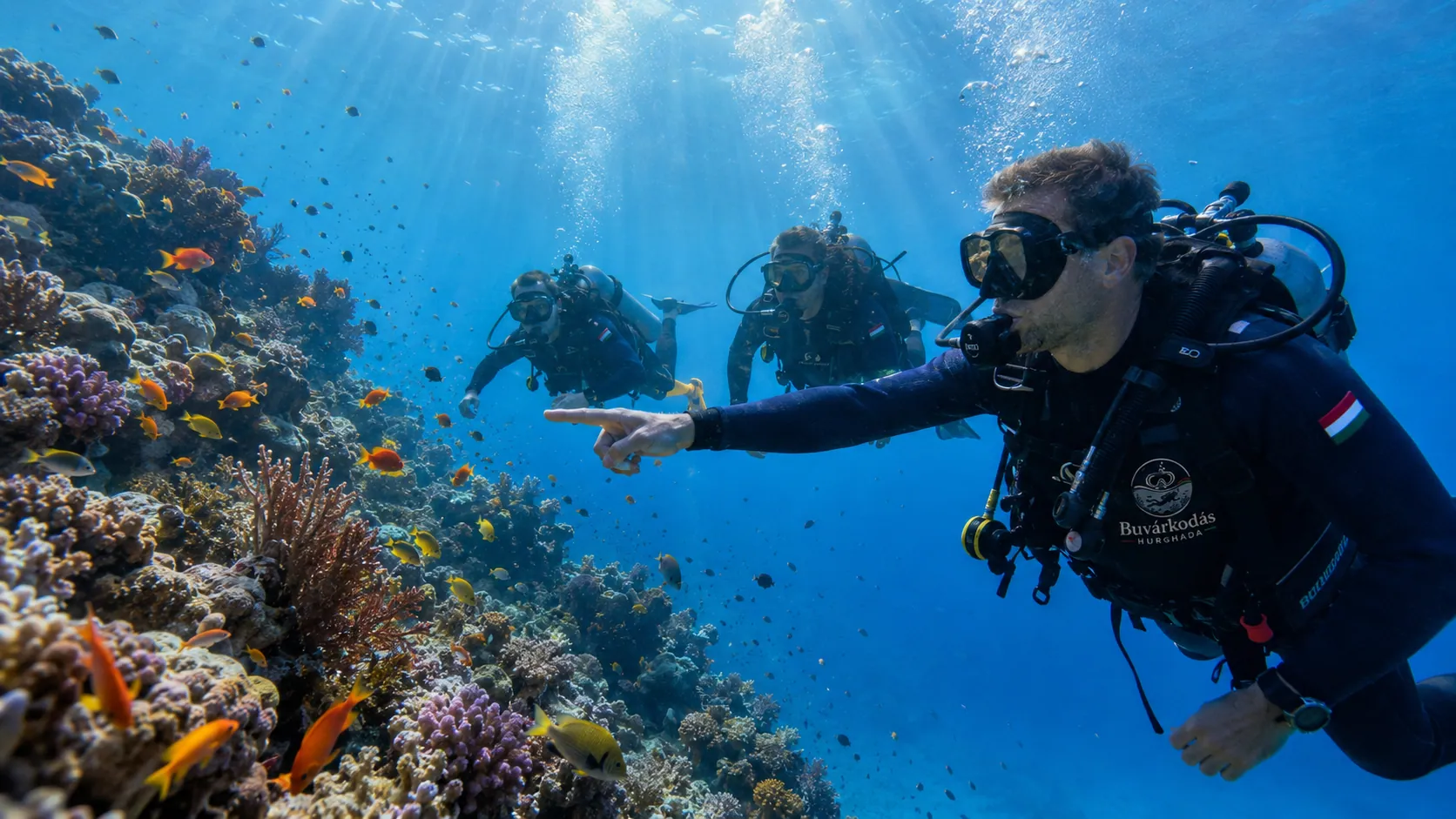
The day consists of two dives with a long surface interval in between, a hot lunch and drinks – and if you feel like it, you can snorkel during the break. We dive in small groups with qualified guides and are back in the harbour by 16:00. Can't get enough of the sea? Add a third dive for just €15.
- 7:15–7:45 – pickup at your hotel
- 8:00 – the boat departs; briefing on the way
- Morning – first dive (about 45–60 minutes)
- Lunch and surface interval on deck
- Early afternoon – second dive
- 16:00 – back in the harbour, transfer to your hotel
For beginners: from intro dive to your first certification
If you've never dived before, there are two ways under the surface. The intro dive (€60) is the simplest: after a short theory session and shallow-water practice, your instructor stays within arm's reach throughout a real reef dive – no certification or experience needed, just basic comfort in the water.
If diving grabs you seriously – and in our experience it does – the Open Water Diver course (€390) earns you an international certification in 3–4 days, valid worldwide to 18 metres. Everything is included: materials, equipment, four open-water dives and the certification fee.
Non-diving travel companions don't have to stay on the beach either: the snorkelling programme (€35) takes them on the same boat to the same reefs – so the family spends the day together at sea.
For certified divers: daily diving and packages
For certified divers the daily boat trip is the core programme: €60 buys two guided dives on Hurghada's most beautiful reefs, with transfers and lunch included. For longer stays the packages are the real deal: 3 days for €165 (€55/day) or 5 days for €250 (€50/day).
Bring your own equipment or rent from us: €15/day, €40 for 3 days, and just €10/day from 5 days on. Nitrox-certified divers pay €8 per tank for enriched air, and returning guests get a 10% loyalty discount.
- Daily diving (2 boat dives): €60
- 3-day package (6 dives): €165 – that's €55 per day
- 5-day package (10 dives): €250 – that's €50 per day
- Third dive on the same day: +€15
- Shore dive: €35
- Equipment rental: €15/day, €40 for 3 days, €10/day for 5+ days
- Nitrox: €8 per tank · Loyalty discount: 10%
The best dive sites in a nutshell
Among Hurghada's dozens of dive sites there's something for everyone – from shallow coral gardens to deep walls and wrecks. We cover the full top 10 in detail in our article on Hurghada's best dive sites; here are the most popular:
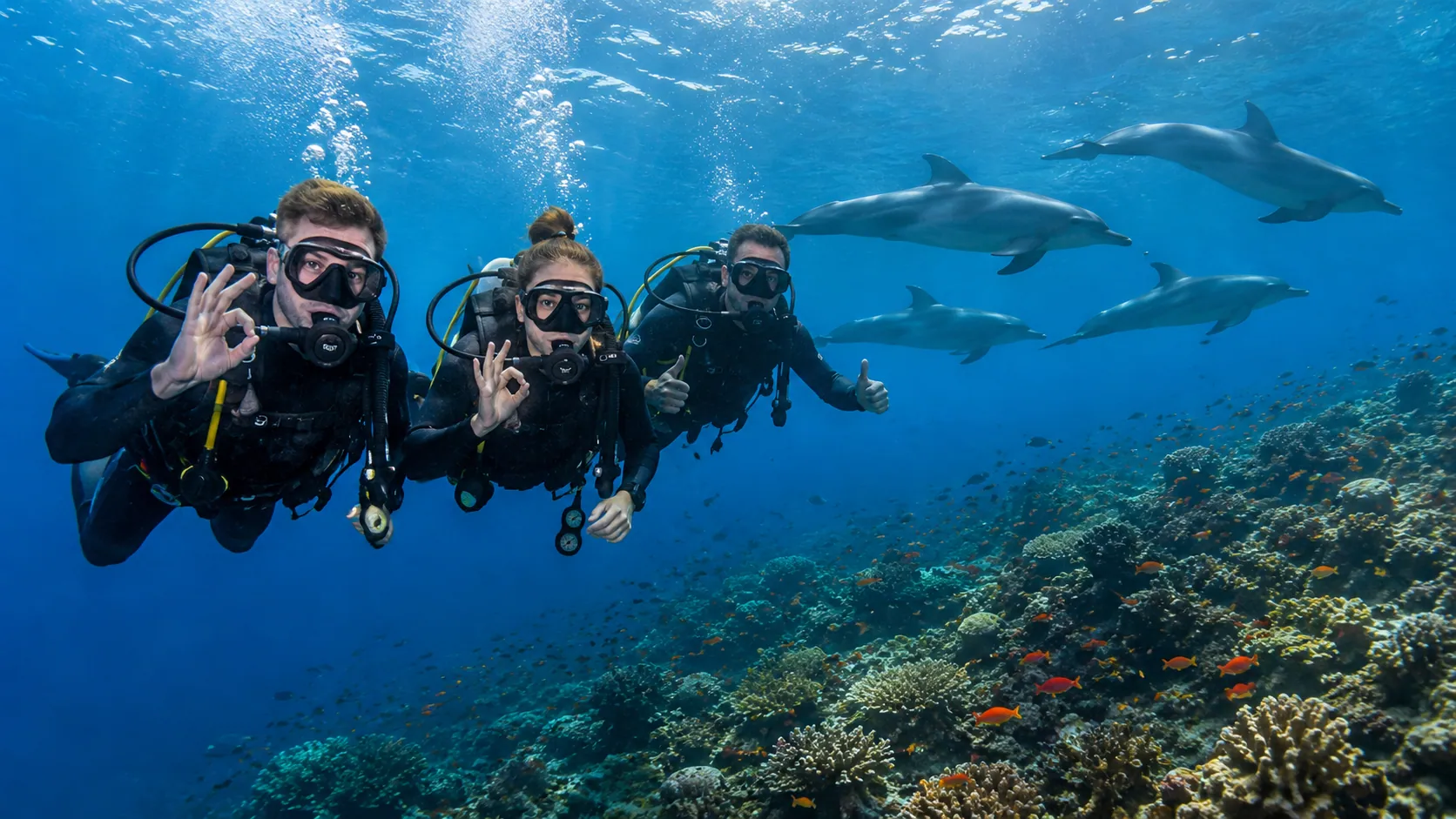
- Dolphin House (Sha'ab El Erg) – a horseshoe-shaped reef where you regularly meet bottlenose dolphins
- Giftun Islands – protected coral gardens and walls in the national park, from beginner to advanced
- El Fanadir – a long, gentle reef wall with turtles and bluespotted rays, barely half an hour from the harbour
- El Mina wreck – an Egyptian navy vessel lying at 25–32 metres, for advanced divers
- Carless Reef – open-sea coral towers with giant morays, for experienced divers
Marine life: what you can see underwater
The northern basin of the Red Sea is one of the most colourful marine ecosystems in the world: over 1,000 fish species and more than 200 coral species live here, and roughly every tenth species is found nowhere else on Earth.
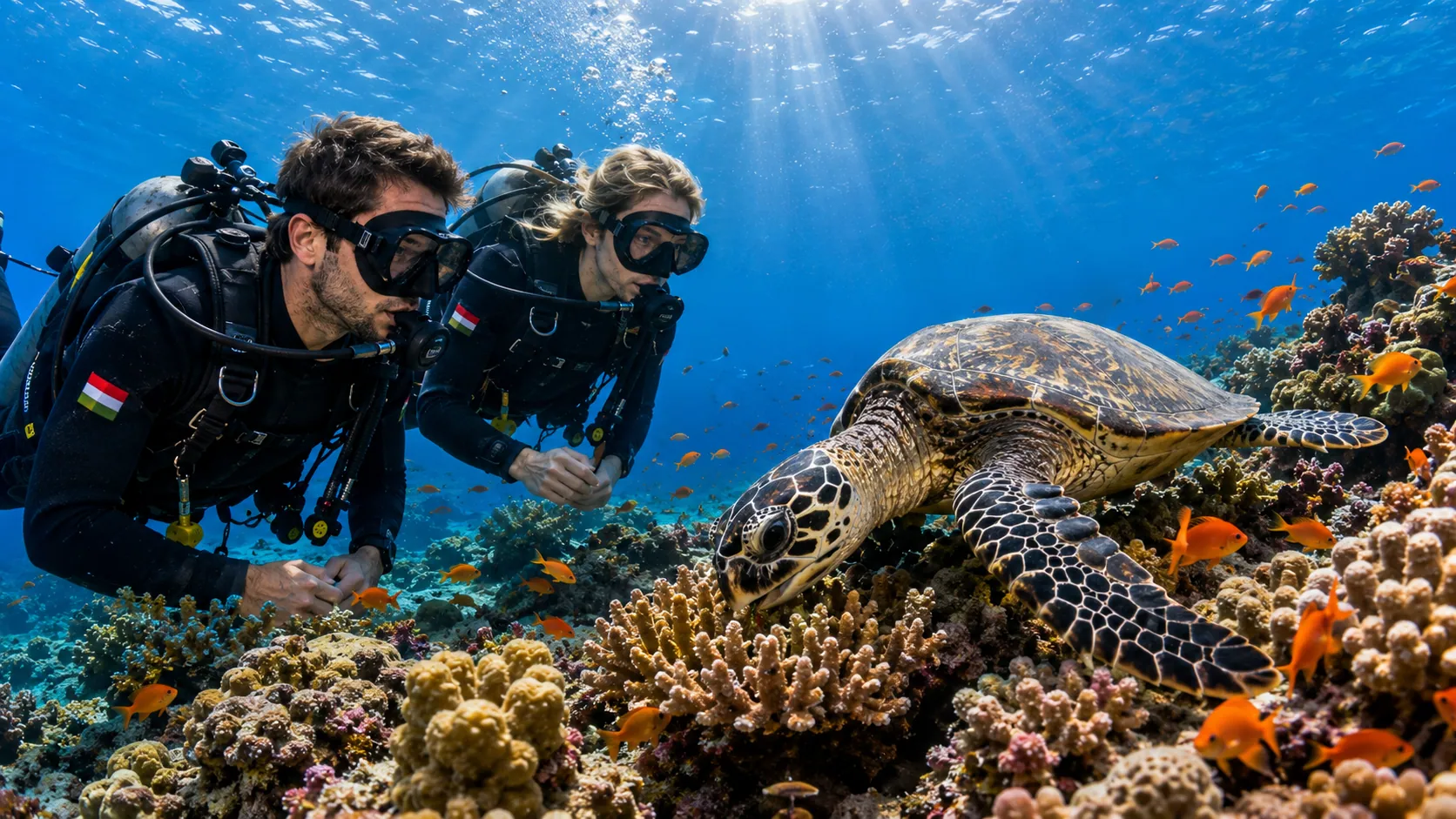
Clownfish, parrotfish and angelfish are guaranteed on your very first dive, but the real stars of Hurghada's reefs are the bigger encounters: dolphins, green sea turtles, bluespotted rays and the morays winding between the corals.
- On almost every dive: clownfish, parrotfish, angelfish, surgeonfish, lionfish
- Frequently: green sea turtles, bluespotted rays, morays, Napoleon wrasse
- With luck: bottlenose dolphins – especially around Dolphin House
- More rarely, at deeper sites: eagle rays, barracuda schools, reef sharks
- On night dives: Spanish dancers, crocodile fish, hunting morays
When to come: seasons, water and air temperature
- Winter (December–February): water 22–24°C, air 20–25°C – comfortable in a 5 mm full wetsuit, and tourist traffic is at its lowest
- Spring (March–May): water 23–26°C, air 25–32°C – a warming sea and calm conditions
- Summer (June–September): water 27–29°C, air 33–40°C – shorty-wetsuit diving and long days
- Autumn (October–November): water 26–28°C, air 26–32°C – many say the best season: warm sea, pleasant air
- Visibility: 15–30 metres all year round
- Diving season: all 365 days of the year – there's no bad period, just different faces of the sea
Practical tips for your trip
The logistics of a Hurghada diving holiday are simple, but a few details are worth planning ahead. The most important rule is the no-fly interval: leave 18–24 hours between your last dive and your flight home – so plan your final full day for the beach or the town.
Check that your travel insurance covers diving (most basic policies can be extended with an add-on); during our courses, dive insurance is included in the price. Booking with us is free, and you pay on site in cash or by card.
- Pack: swimsuit, towel, sunscreen (preferably reef-safe), sunglasses, hat
- Bring your own mask or dive computer if you like – everything else can be rented (€15/day)
- Mandatory: 18–24 hours without diving before your flight
- Tipping: €5–10 per day for the boat crew is customary but entirely voluntary
- Payment: euros in cash are the most practical, cards accepted too; you'll hardly need Egyptian pounds
- Don't leave your logbook and certification card (or the app version) at home
Why a Hungarian-speaking dive center matters
In diving, safety depends on precise communication. A briefing you only half understand through foreign technical terms becomes a risk underwater – in your own language, every detail falls into place: the dive plan, the hand signals, the emergency procedures.
As a beginner this matters even more: you dare to ask questions, you can say exactly what worries you, and your instructor can respond immediately and precisely. Course theory and exams run in Hungarian too – with English available as well.
That's exactly why Búvárkodás Hurghada exists: so the Red Sea experience never requires a language compromise. Write to us or book online – booking is free, and we reply in your language.
Frequently asked questions
Yes. Dives run with qualified guides, in small groups, to international SSI/PADI standards, with briefings in your language. Entry-level sites are shallow and sheltered from currents, and if you respect the 18–24 hour no-fly rule, diving is one of the safest water sports there is.
A two-dive boat day is €60, a 3-day package €165 and a 5-day package €250. An intro dive costs €60, snorkelling €35, and the Open Water course €390 including materials, equipment and certification. Equipment rental is €15/day, or €10/day from 5 days.
Yes, but it's very simple: either apply for an e-visa online in advance or buy a visa on arrival at Hurghada airport (about 25 USD). Your passport must be valid for at least six months from entry.
Any time – the season lasts 365 days. The water is 22–24°C in winter and 27–29°C in summer, with 15–30 metres of visibility year round. Most returning divers love autumn best: the sea is still warm, the air is pleasant and the crowds are smaller.
For an intro dive, basic comfort in the water is enough – your instructor stays within arm's reach at all times. For the Open Water course the prerequisite is a 200-metre continuous swim (or 300 metres with a snorkel), any style, no time limit.