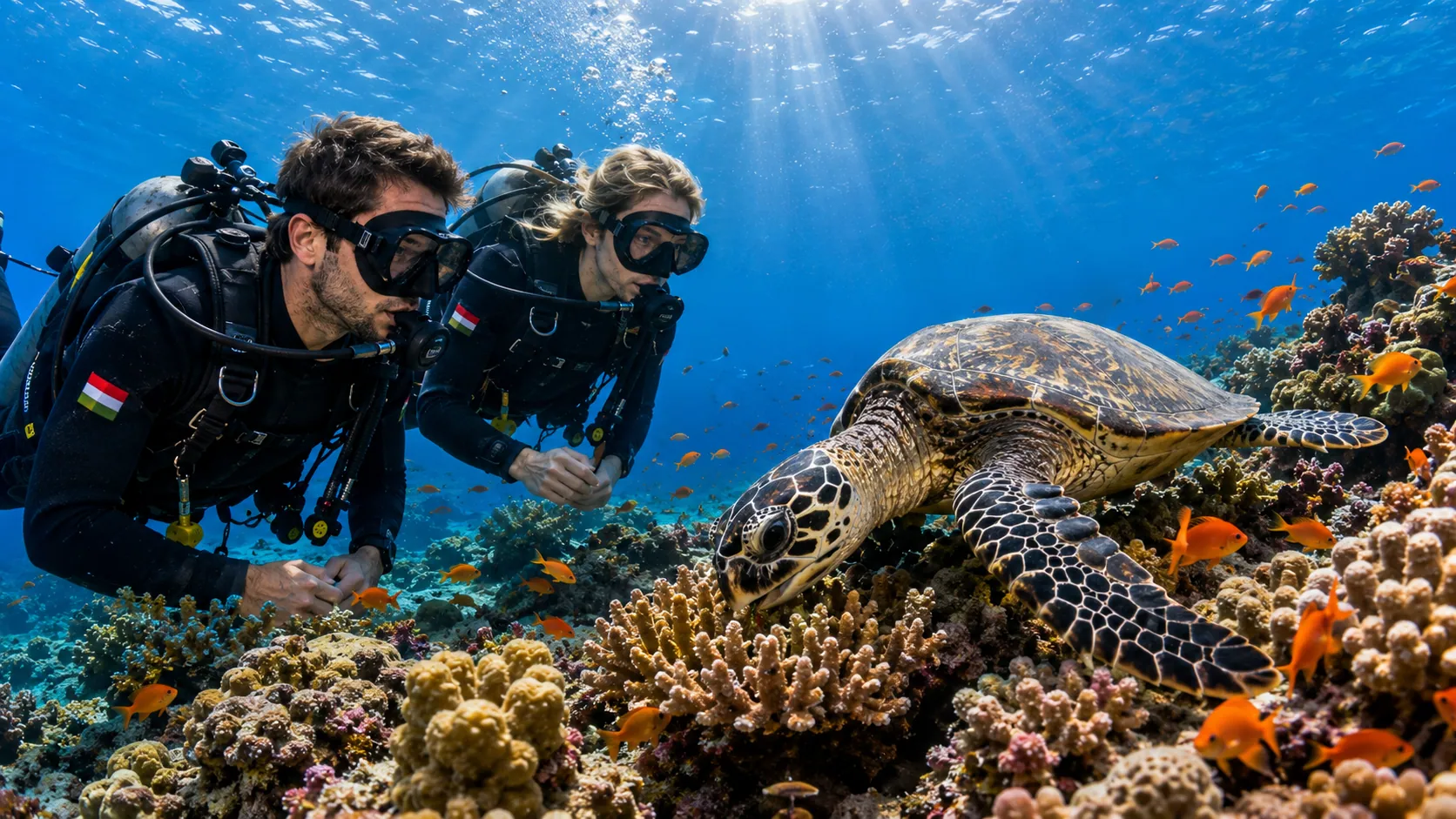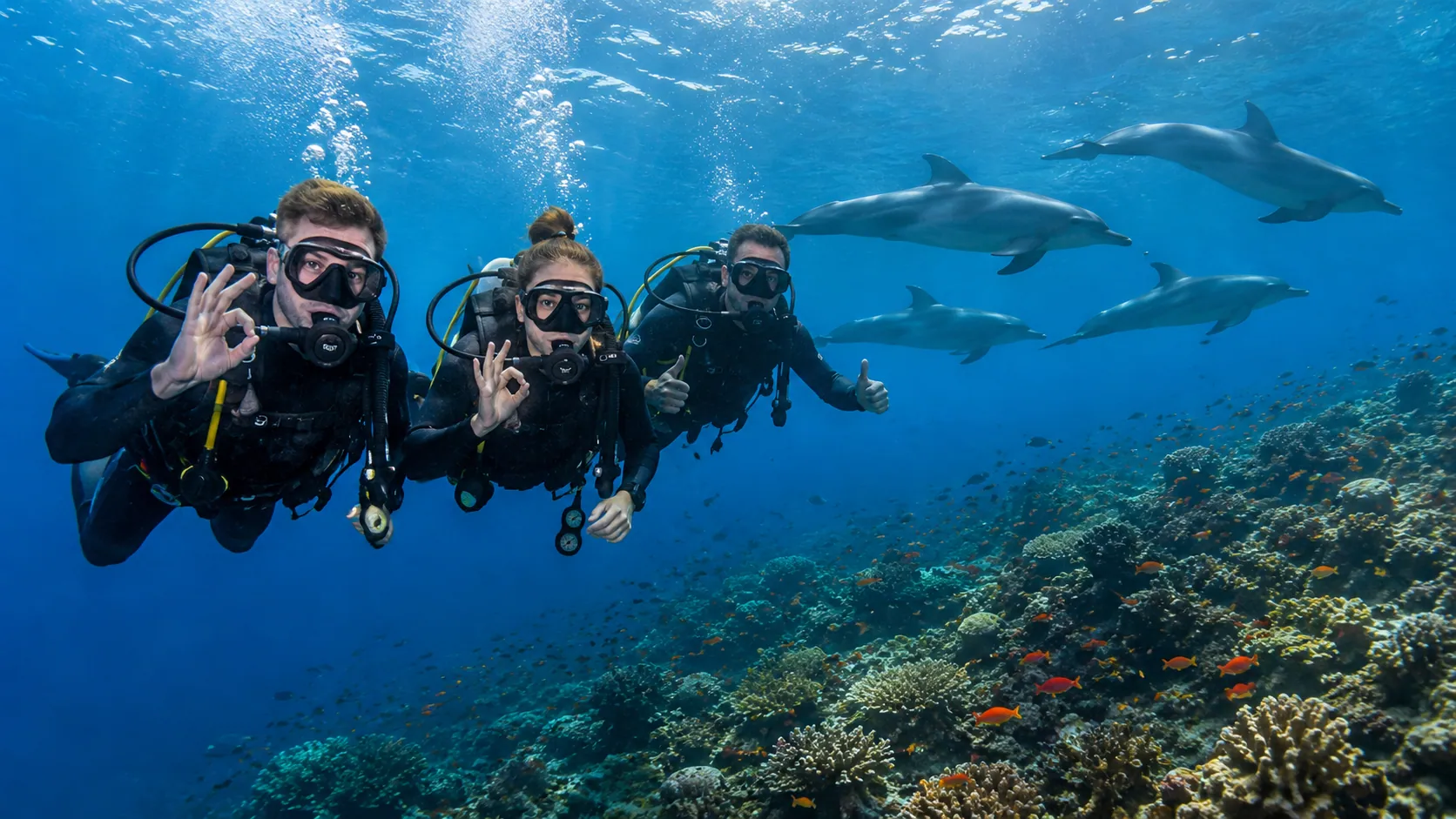
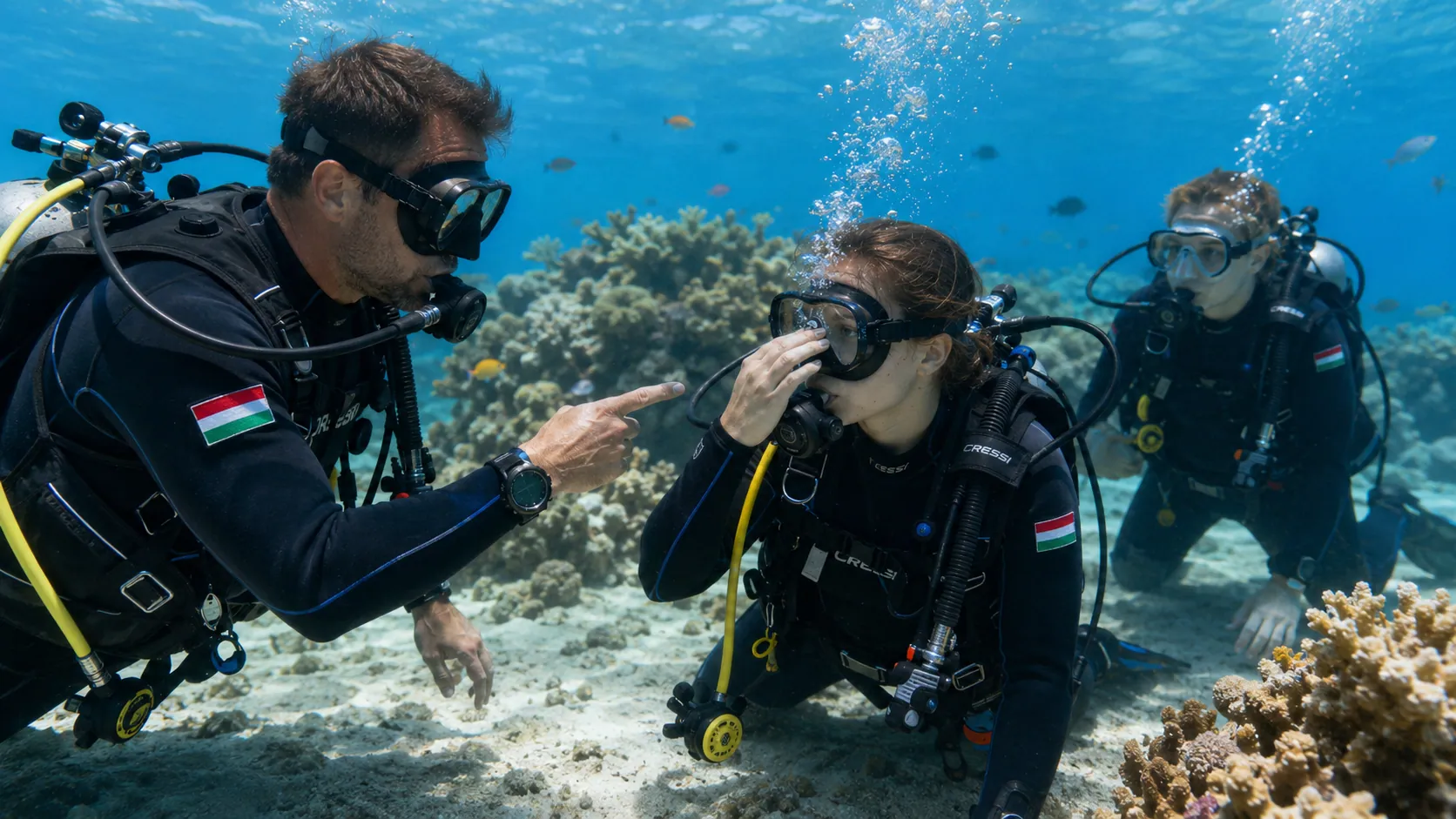
Everyone is nervous before their first dive – and that is completely fine. The good news: a try dive requires no experience at all, an instructor stays right beside you the whole time (literally holding your hand if you want), and everything moves at your pace.
In Hurghada a try dive costs €60, and the Red Sea is one of the best places in the world for your first breath underwater: warm, crystal-clear water, calm shallow reefs and marine life that elsewhere would take days of sailing to reach.
In this article we walk through the day step by step, honestly answer the five most common beginner fears, and show you what to pack – so that on the big day the only thing left to focus on is the experience.
What exactly is a try dive?
A try dive (also called an intro dive or discover scuba diving) is a real scuba dive – without a course, an exam or a certification. With us it costs €60 and has no prerequisites: no dive card needed, no need to be a champion swimmer, and nothing to study in advance.
Here is the part many people do not know: a qualified instructor stays directly beside you the entire time and – if you want – literally holds your hand underwater. They manage your equipment and control the depth and direction; your only job is to breathe and look around.
A try dive goes to a maximum of 10–12 metres, over calm, shallow reefs – exactly where the Red Sea is at its most colourful. You do not need to memorise anything: the pre-departure briefing covers everything important, in Hungarian.
Your day step by step
- Morning transfer: we pick you up at your hotel and take you to the marina – the boat leaves at 08:00
- Briefing in Hungarian: your instructor explains the equipment, the breathing rules, equalization and the hand signals – ask anything you like
- Gear fitting: mask, fins, wetsuit and BCD adjusted to you – we have every size
- Getting comfortable: you first get used to breathing from the regulator at the surface and in shallow water – you stay there until it feels natural
- The dive: 20–30 minutes over the coral reef at a maximum of 10–12 metres – your instructor within arm's reach the whole time
- Rest on the boat: hot lunch, drinks, sunbathing and, if you feel like it, snorkelling over the reef
- Return: we are back at the marina around 16:00, then transfer you to your hotel
The 5 most common fears – answered honestly
- “My ears will hurt” – Equalizing is one simple move (pinch your nose and blow gently) that you practise on land first. Descend slowly and equalize early, and it does not hurt – your instructor watches you constantly and you can pause at any time.
- “Water will get into my mask” – It happens, and it is no problem: a few drops in the mask are completely normal. Your instructor shows you how to clear it with a single exhale through your nose – no need to even surface for it.
- “I will run out of air” – Your tank holds far more air than you could possibly use on a try dive, and your instructor checks your gauge every few minutes. They also carry a spare regulator – you are never left without air.
- “I will get seasick” – We reach the sheltered reefs quickly, and underwater you feel none of the waves at all. If you are sensitive, take a travel sickness tablet before departure, watch the horizon – and tell us in advance so we can pick the calmest site.
- “What about sharks?” – Seeing a shark at Hurghada's daily dive sites is rare luck, not a danger: reef sharks are shy and humans are not on their menu. On a 10–12 metre try dive you will almost certainly see clownfish, parrotfish and a moray eel – and almost certainly no shark.
The golden rules of breathing
The first and most important rule of diving: never hold your breath. Underwater you breathe continuously and calmly from the regulator – exactly as you would at the surface, just through your mouth.
The secret is slow, deep breathing: it calms your nervous system, uses less air and makes your buoyancy more stable. The first minute or two feels strange – “I am really breathing underwater!” – then your brain adjusts, and from that point on it is the most natural thing in the world.
If you ever feel uneasy down there: stop, hold your instructor's arm and take five slow, deep breaths. This simple trick dissolves almost every beginner's nerves – and your signal tells the instructor instantly that you need a short pause.
Equalization explained simply
As you descend, the water pressure increases and your ears notice it first – the same feeling as a plane landing. The fix is simple: pinch your nose, close your mouth and blow gently, as if trying to exhale through your nose. A soft pop, and the pressure feeling is gone.
The two golden rules: equalize early and often – start in the very first metres and repeat every metre – and never force it to the point of pain. If it will not clear, ascend half a metre and calmly try again; your instructor always adjusts the pace to this.
Good news: you practise the move on land during the briefing, and swallowing or wiggling your jaw helps too. There is one firm rule: never dive with a cold or a blocked nose – postpone the dive a few days instead, your booking can be changed free of charge.
Who can try it – and who should see a doctor first?
Anyone from age 10 can do a try dive, and even swimming skills are not required: the equipment keeps you afloat at the surface, and underwater your instructor is in control throughout. Before the dive you fill in a short medical questionnaire – most people pass it without any issue.
In some cases, though, we ask for a medical consultation first – not to discourage you, but because your safety comes before everything else. If any of the points below applies to you, talk to your GP or a diving doctor before booking:
- Asthma, heart or lung conditions, epilepsy, diabetes, ear or sinus surgery, or regular medication all require a doctor's approval
- Diving while pregnant is off the table – snorkelling (€35) is a safe alternative
- Postpone the dive if you have a cold: equalization does not work with a blocked nose
Fell in love with it? The next step
Most first-timers surface with an enormous grin, and their first question is: “when can I go again?” If that happens to you, the natural next step is the Open Water Diver course: €390 all-inclusive, 3–4 days, taught in Hungarian – and at the end you hold a lifetime international certification that lets you dive to 18 metres anywhere in the world.
We will be honest: formally, the try dive does not count towards the course – the standards require you to complete all the OWD exercises either way. In experience and confidence, however, it counts enormously: you already know the breathing, the equalization and that unforgettable first underwater feeling, so day one of the course will greet you like an old friend.
And if you do not want a course right away? No problem: you can do another try dive any time, even on your next holiday. The advantage of certification is the freedom that follows – for example daily dive trips (€60) or multi-day packages (3 days €165, 5 days €250).
What to bring – packing list
- Swimsuit (wear it in the morning) and a towel
- High-SPF, ideally reef-friendly sunscreen – the sun on the boat is strong
- Sunglasses and a cap for the time at the surface
- A light jumper or windbreaker for the boat (essential in winter)
- An ID or a copy of your passport for the marina checkpoint
- A seasickness tablet if you are sensitive – take it before departure
- A waterproof phone case or action camera if you want memories – photo packages are also available on board
- A good mood and a bit of healthy excitement – the rest (equipment, lunch, drinks) is on us
Frequently asked questions
It is not a requirement: the equipment keeps you afloat at the surface, and underwater you are beside your instructor the whole time. Basic comfort in the water helps a lot, of course. Dive courses – such as the Open Water – do require basic swimming skills.
A maximum of 10–12 metres, but you set the pace: if you feel best at 5 metres, that is where you stay. The Red Sea is at its most colourful in the top few metres anyway – you find most of the corals and fish at just 3–6 metres.
Your instructor is trained exactly for this: you agree on the hand signals during the briefing, and you can signal at any time to pause or go up. You can always return to the surface slowly, together with your instructor. In our experience, the nerves turn into pure joy within the first few minutes for almost everyone.
From age 10, after filling in a short medical questionnaire. Younger or non-diving family members can snorkel from the boat (€35) – so the whole family spends the day at sea together.
No: 18–24 hours must pass between your last dive and your flight. That is why you should plan the try dive for the beginning or middle of your holiday – so if you fall in love with it, there is still time to dive again or even start the Open Water course.