With the Open Water Diver (OWD) course you become an internationally certified diver in 3–4 days, licensed to dive to 18 metres in any sea in the world. With us in Hurghada the course costs €390 with everything included: materials, equipment, all dives and the certification – and the teaching runs in Hungarian throughout, with English available too.
This article walks you through the course step by step: what you learn on each day, how the open-water dives work, what to expect at the exam, and how to prepare at home so that as much of your holiday as possible stays free.
We also write honestly about the fears – ear pressure, water in the mask, running out of air – because almost everyone has them, and every single one has a simple, learnable solution.
What is the Open Water Diver, and what does the card let you do?
The Open Water Diver is the world's most widespread entry-level diving certification: it means the same thing in both the SSI and PADI systems – you are an independent, responsible diver who may dive with a buddy, without instructor supervision. The certification never expires: you earn it once and it's yours for life.
Your card (nowadays typically digital, in a phone app) is valid all over the world: show it at any dive base from Bali to the Canary Islands, and you're diving.
- Maximum depth: 18 metres
- Validity: for life, no renewal needed
- Recognition: worldwide, at every dive center
- Entitlement: tank and equipment rental, boat dives, diving with a buddy
- Next steps: Advanced Open Water (to 30 metres), specialty courses
The course day by day
The course takes 3–4 days – and if you finish the e-learning at home, 3 days on site are enough. Here's how it's structured:
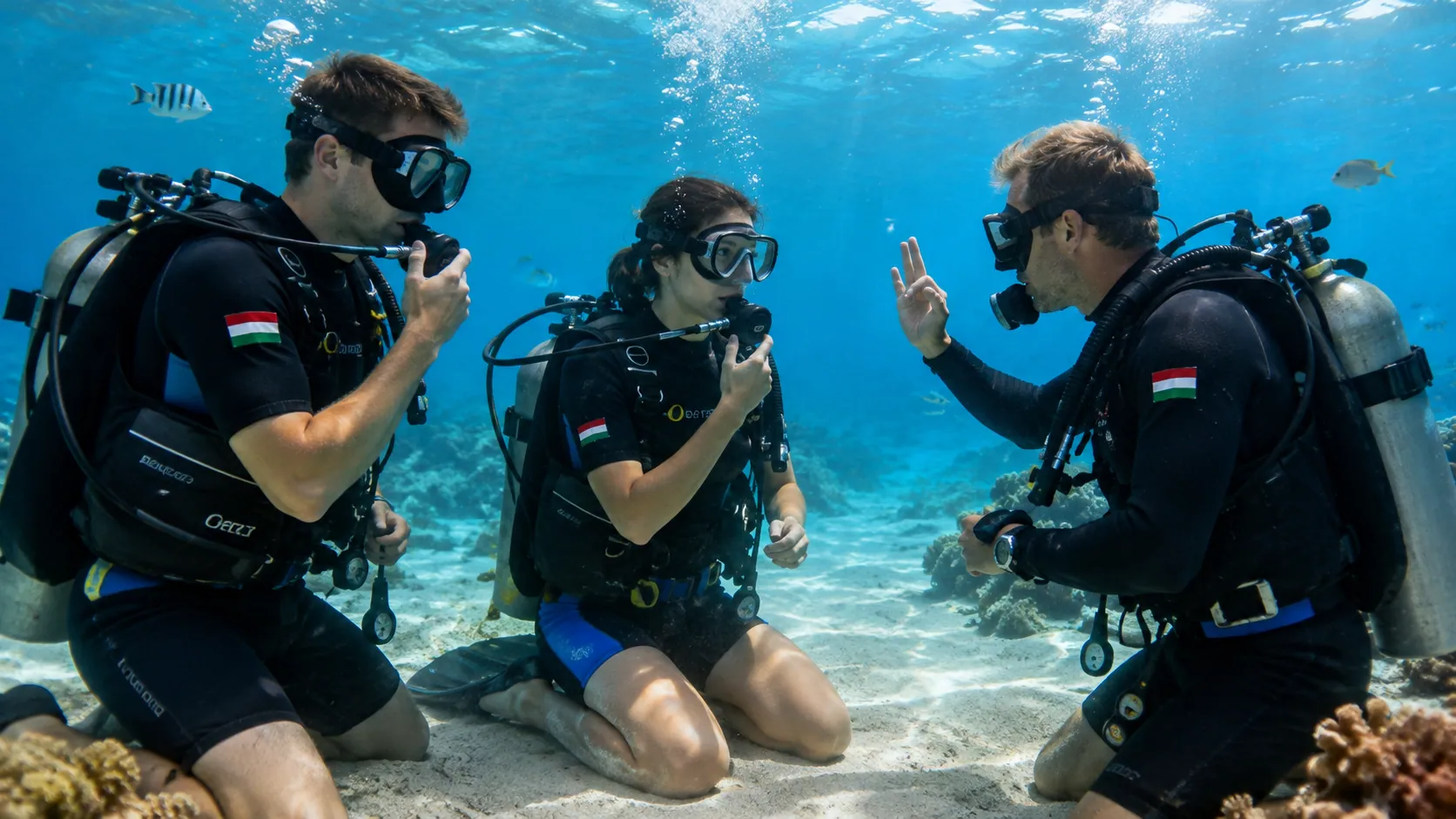
Every skill is practised first in shallow, standing-depth water, and only then do we dive in open water. There's no time pressure: everyone progresses at their own pace, and your instructor stays with each skill until you're confident.
- E-learning (at home or on site): 6–8 hours of digital materials – physics, physiology, equipment, safety
- Day 1: theory review + core skills in shallow water (mask clearing, regulator recovery, buoyancy)
- Day 2: boat day – skill practice, then your first two open-water dives to 12 metres
- Day 3: open-water dives 3–4, down to 18 metres – navigation, buoyancy control, independent diver skills
- Day 4 (or the end of day 3): a short theory exam + your digital certification card is issued
SSI or PADI? In short: there's no wrong choice
Both organisations' certifications are accepted worldwide, their training standards are nearly identical, and with us the price is the same: €390. For the value of your card it genuinely doesn't matter which you pick.
There are small differences: SSI's materials are fully digital and handle the order of skills more flexibly, while PADI is the world's largest and best-known diving organisation. As a recreational diver you'll do exactly the same dives with either – if you have professional ambitions, check which agency has more bases in your target country.
Just tell us which one you'd like when you book – we teach both systems regularly and routinely.
Why learning in the Red Sea beats a lake or a pool
Anyone who has trained in a cold quarry lake, with one metre of visibility, in a thick wetsuit, knows exactly why the Red Sea is different. Here you practise in 25–29°C water for most of the year, in a thin suit, with 15–30 metres of visibility – meaning you can always see your instructor, your buddies and the bottom.
That's not just comfort, it's learning psychology: warm and with good visibility, you're far calmer, skills stick faster, and from the very first moment your memory of diving is one of joy, not struggle.
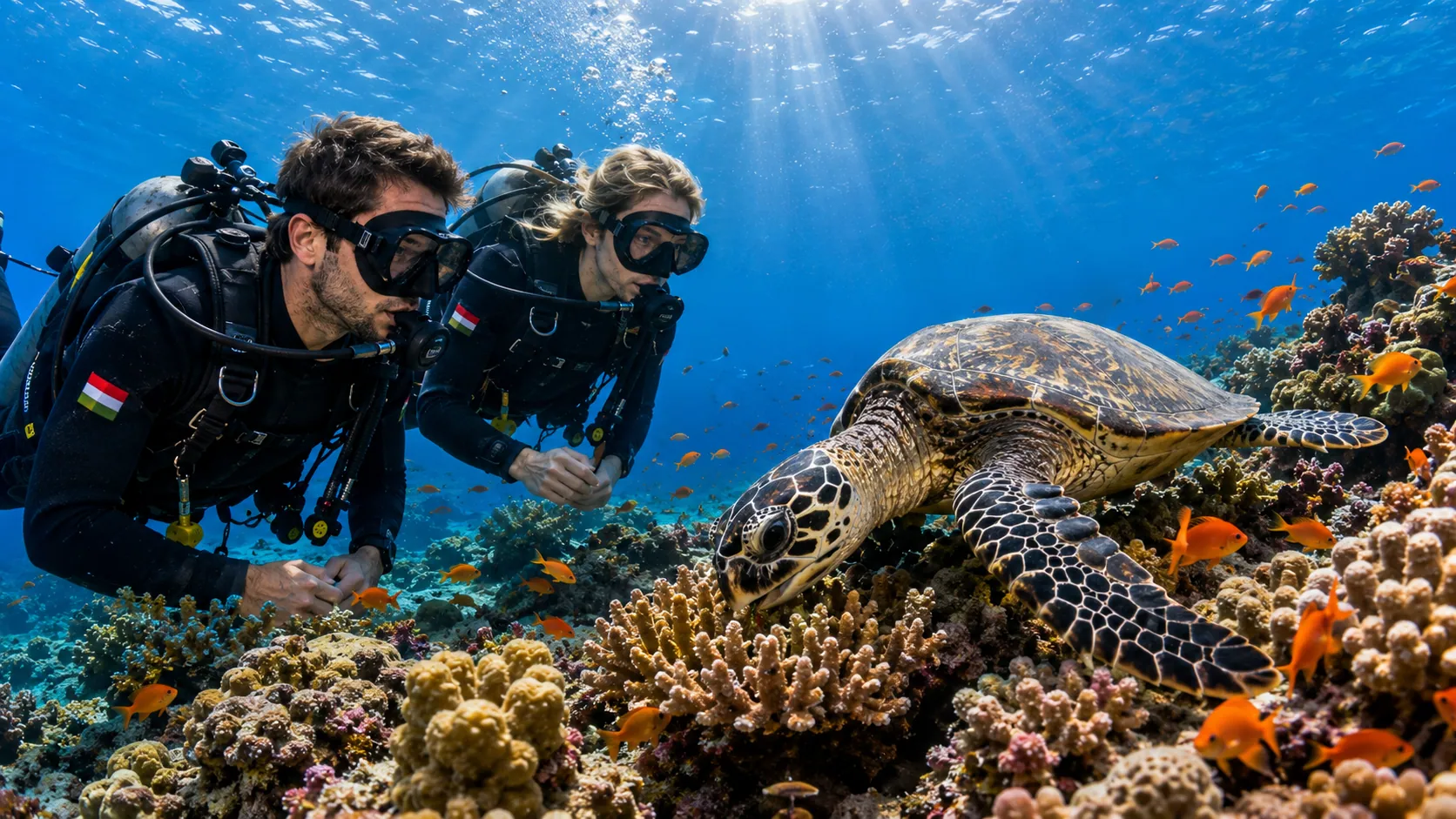
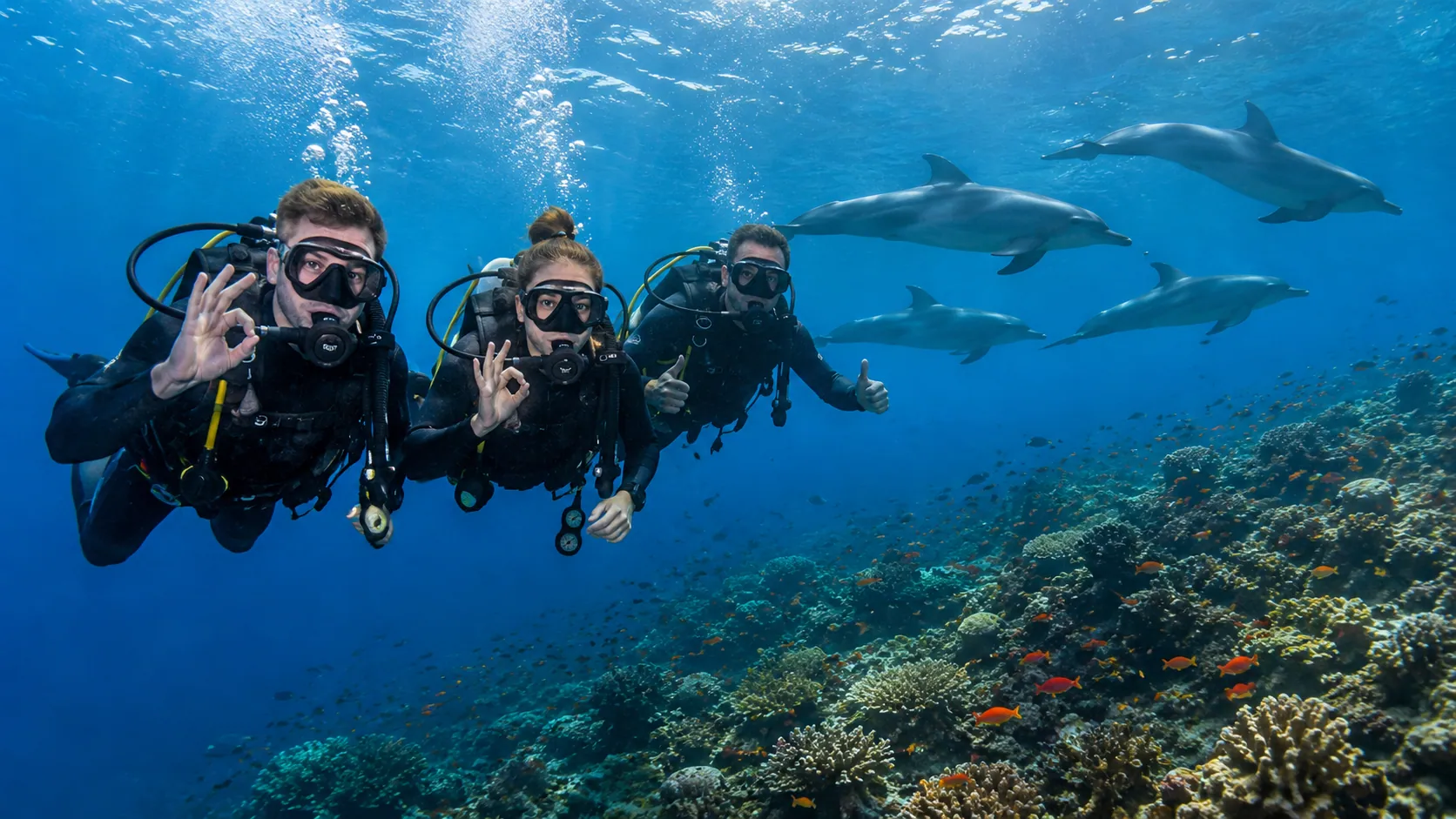
And the essence of it: clownfish, parrotfish and corals surround you from your very first training dive. The moment an angelfish glides past while you're practising mask clearing – that wins everything.
What exactly does the €390 include?
- A Hungarian-speaking SSI or PADI instructor throughout the course
- Complete digital learning materials
- All shallow-water sessions and all 4 open-water dives
- Full diving equipment for the duration of the training
- Boat days with hot lunch and drinks
- Hotel transfers on every training day
- International certification fee and digital diver card
- Dive insurance for the duration of the training
- Not included: tips (voluntary) and the optional photo-video package
How to prepare at home
You don't need an athletic background for the OWD – but a few things are worth sorting out before you travel, so everything runs smoothly on site:
- Swimming: a 200-metre continuous swim (or 300 metres with a snorkel) is the prerequisite – any style, no time limit
- Medical questionnaire: you fill it in before the course; certain answers (e.g. asthma, heart conditions) require a doctor's clearance – arrange that at home
- E-learning: complete the 6–8 hours of theory at home – it saves you a full holiday day
- Don't come with a cold: equalising doesn't work with a blocked nose – push the start back a day if needed
- Timing: you can only fly 18–24 hours after your last dive – don't schedule the course for your final days
- Packing: swimsuit, towel and sunscreen are enough – we provide all the diving equipment
The three most common fears – and the reality
“What about my ears?” – You need to equalise the growing pressure in your ears as you descend: you learn the pinch-your-nose-and-gently-blow technique in minutes and practise it first in shallow water. We descend slowly and stop whenever needed – ear pain is not part of diving; it's a signal to slow down.
“What if water gets into my mask?” – This is the quickest skill to master: you clear the water with a single exhale through your nose, even after taking the mask off completely. We practise it first in standing-depth water, where you can simply stand up at any moment.
“And if I run out of air?” – You won't without noticing: you follow it on a pressure gauge, your instructor checks it regularly, and we surface with a generous reserve. For emergencies there's also your buddy's spare regulator – we practise that too. Beginners are usually surprised by how long a tank lasts with calm breathing.
The secret is the same for all three fears: you practise every emergency skill in a safe environment until it becomes boring routine. That's exactly what makes diving one of the safest adventure sports.
You've got your OWD – what comes next?
After Open Water, most people continue with the Advanced Open Water (AOWD) course, which extends your depth limit to 30 metres and introduces deep diving, underwater navigation and further adventure dives. With us it's €290, again with everything included.
If one area really excites you, specialty courses (€180) are for you – from night diving through nitrox to wreck diving. For the safety-minded there's the Rescue Diver (€500) and EFR first aid (€200), and the first step of the professional path is the Divemaster (€800).
- Advanced Open Water (AOWD): €290 – a 30-metre depth limit
- Specialty courses (night, deep, nitrox, wreck and more): €180
- Rescue Diver: €500 · EFR first aid: €200
- Divemaster: €800 – the first professional level
- As a returning guest you get a 10% loyalty discount on further programmes
Frequently asked questions
Yes, but you don't need to be a competitive swimmer: the prerequisite is a 200-metre continuous swim in any style with no time limit – or 300 metres with a snorkel. What matters is comfort in the water, not speed.
From age 10. Ages 10–14 earn the Junior Open Water certification, valid to 12 metres, which automatically becomes a full OWD at 15. We often train children together with a parent.
3–4 days. If you complete the e-learning theory at home (about 6–8 hours), 3 days on site are enough – leaving more of your holiday free for the beach and excursions.
No: it's a short multiple-choice test, and your instructor reviews every topic with you beforehand. Almost everyone passes first time – and if not, we go through the gaps together and you retake it at no extra cost.
Yes. The course follows strict SSI/PADI standards: every skill is practised in shallow water before any open-water dive, group sizes are limited, and dive insurance is included for the training. Statistically, diving by the rules is one of the safest adventure sports.