The short answer: SSI and PADI certifications are equivalent, both meet the same international ISO standards, and both are accepted at every dive center in the world. You simply cannot choose wrong – and with us in Hurghada you can train in either system, at exactly the same price.
So why write a whole article about it? Because this is the question future divers ask us most often, and because the internet is full of biased, half-true comparisons – usually written by people who only teach in one of the two systems.
We are active instructors with both organisations, so we have no reason to lean either way. In this article we honestly walk you through how the two systems differ in history, teaching philosophy, materials and cost – and tell you what we think really matters when you choose a dive course.
The short answer: both lead to the same place
SSI (Scuba Schools International) and PADI (Professional Association of Diving Instructors) are the world's two largest dive training organisations. Both are built on the same international standards: the ISO 24801 series and the rules of the WRSTC (World Recreational Scuba Training Council) define what a diver must know at each level – regardless of which logo ends up on the card.
In practice this means an SSI Open Water diver learns the same skills and can dive to the same 18-metre limit as a PADI Open Water diver – anywhere in the world, at any dive center.
With us the stakes are even lower: we teach both systems at the same price. The Open Water course is €390 whether you want an SSI or a PADI card at the end – so all that really matters is which system feels right to you.
SSI and PADI at a glance – the key facts
- PADI: founded in 1966 in the USA – today the world's largest dive organisation, issuing close to a million certifications a year
- SSI: founded in 1970, today part of the HEAD/Mares sports group, present in more than 110 countries
- Both organisations' courses comply with the international ISO 24801 diving standard
- Levels map one to one: OWD = OWD, Advanced Adventurer = AOWD, Stress & Rescue = Rescue
- Both cards are valid worldwide and never expire
- With us the price is identical: OWD €390, AOWD €290, specialties €180 – whichever system you choose
History and size: two giants
PADI was founded in Chicago in 1966 by John Cronin and Ralph Erickson, with the goal of making dive training accessible to everyone. The plan worked: PADI has grown into the world's largest dive organisation, and for many people the brand is practically synonymous with diving itself.
SSI is only four years younger: it started in 1970, also in the United States. For a long time it played the challenger, but today it is huge in its own right: partner schools operate in more than 110 countries, and since 2014 it has been part of the HEAD sports group – the same family that owns the Mares dive brand.
From your point of view, the size difference is irrelevant: both organisations have decades of history, a worldwide presence and solid backing behind their instructors. Neither card has a “smaller” or “weaker” organisation behind it.
Training philosophy: how does the teaching differ?
PADI's system is built on full standardisation: you learn the skills in a fixed order, in set modules, and the performance requirements are identical everywhere in the world. The big advantage is predictability – a PADI course is structured the same way in Hurghada, in Thailand or at a Hungarian lake.
SSI prescribes the same final requirements but gives the instructor more freedom in the order and pace of teaching. This lets the training adapt to you: if something is harder, you spend more time on it; if something clicks instantly, you move on faster. SSI instructors also always teach through a dive center, while PADI instructors can teach independently.
And now the honest part: as a student you will barely notice any of this. A good instructor tailors the pace to you within PADI's framework too, and a weak instructor is not saved by SSI's flexibility. Safety rules, maximum group sizes and exam requirements are equally strict in both systems.
Digital materials and costs
- SSI: the MySSI app and the digital learning materials are free – register and study on your phone whenever and wherever you like
- PADI: the eLearning materials are paid, and at many dive centers they appear as a separate item on top of the course price
- With us this doesn't matter: materials are included in the course price in both systems – the €390 OWD covers everything
- Both apps also hold your digital certification card and your dive log – your phone becomes your diver ID
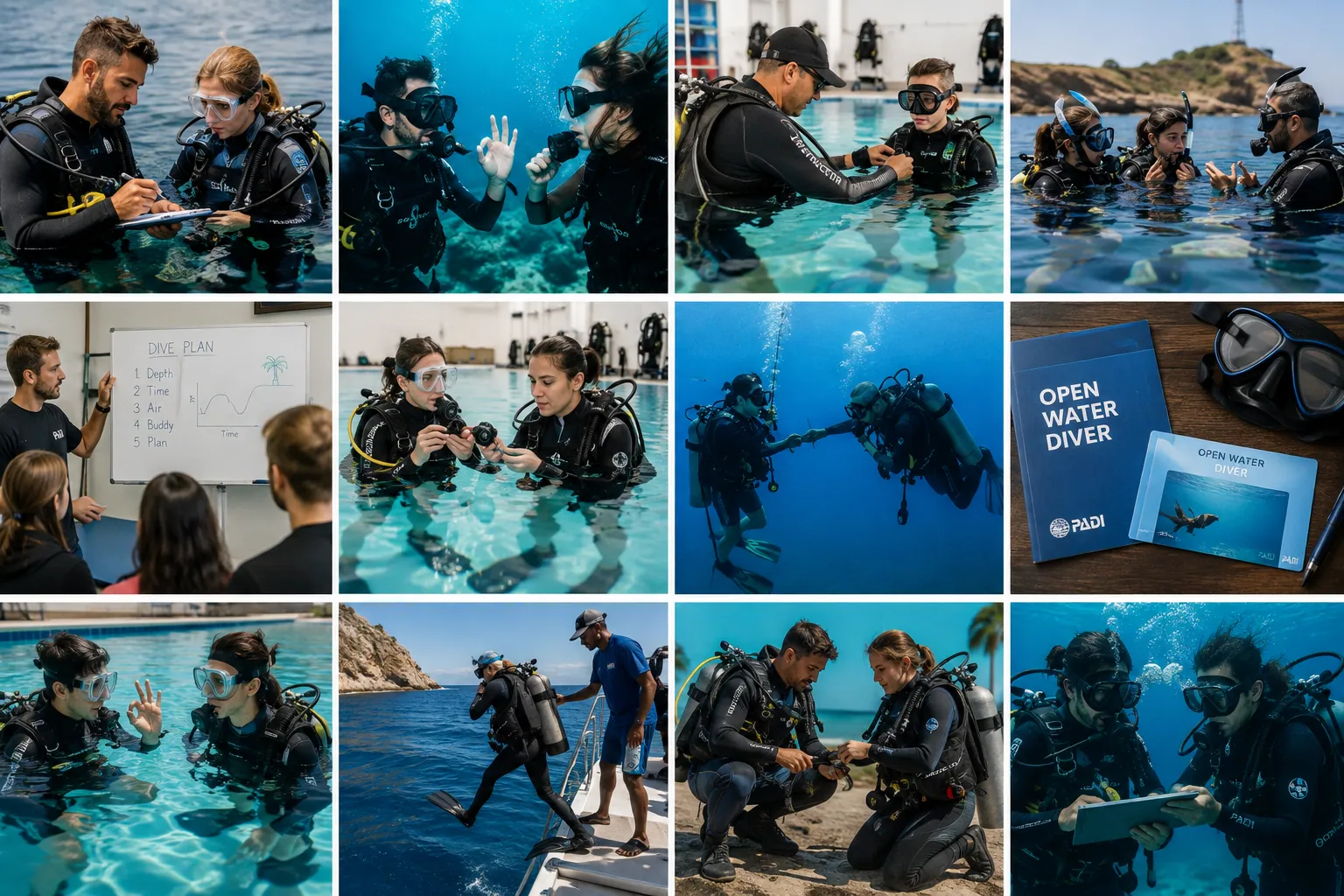
- In both systems your instructor goes through the theory with you live, in Hungarian – you are never left alone with the material
Myth: “a PADI card is accepted in more places”
One of the most common myths we hear: “PADI is accepted everywhere, SSI isn't recognised in some places.” This is simply not true. Every dive center operating to international standards accepts both organisations' certifications – along with CMAS, NAUI and every other ISO-compliant system.
As instructors we have dived and worked in many parts of the world over the years, and we have never once seen an SSI card turned away at any dive center. The myth most likely comes from PADI's stronger marketing – the brand is better known, but the acceptance is identical.
What dive centers actually look at when you check in: your certification level, your number of logged dives, and how recently you last dived. The logo on your card sits at the very bottom of that list – if it is on the list at all.
Crossover: you can freely mix the two
The levels of the two systems map one to one, so you can switch between them at any time – no extra exam, no bridging course, no additional fee. You simply sign up for the next level in the other system with your existing card.
In practice this means you can freely mix the two throughout your diving life – what counts is your logged dives and your skills, not the order of the logos.
- SSI Open Water Diver = PADI Open Water Diver (18 m)
- SSI Advanced Adventurer = PADI Advanced Open Water Diver (30 m)
- SSI Diver Stress & Rescue = PADI Rescue Diver
- SSI and PADI specialty courses recognise each other mutually
- Example: you take the SSI Open Water with us (€390), then continue next year with a PADI Advanced course (€290) – or the other way round
Which do we recommend – and for whom?
Honestly: for the vast majority of divers it makes no difference at all – you will know the same things, dive the same places and, with us, pay the same price. There are, however, a few angles that can help you decide.
And if you still cannot choose: you can decide even on the first day of the course. The price, the instructor, the boat and the reef are the same – only the card differs.
- Choose SSI if you like the free app and appreciate training that flexes around you
- Choose PADI if the world's best-known dive brand gives you peace of mind, or your dive buddies are all PADI divers
- If you plan to work in diving: both systems' professional levels are recognised worldwide – it makes sense to train in the system your future workplace teaches
- If someone in your family is already certified: sharing one system and one app is convenient – but mixing is perfectly fine too
The bottom line: the instructor matters, not the logo
If you take one sentence away from this article, let it be this: the quality of your course is determined by the instructor standing next to you in the water, not by the logo on your card. Their patience, experience and attention matter – along with group size, practice time and the conditions you learn in.
So the right questions are not “SSI or PADI?” but: How big is the group? What language is the course taught in? What exactly does the price include? How much practice time do I get?
Our answers: small groups, teaching in Hungarian, all-inclusive prices – and both systems at the same price. Whichever you choose, the same Red Sea awaits you with the same care. If you are unsure, just write to us – our instructors are happy to help you decide.
Frequently asked questions
Neither is better than the other: both meet the same ISO standards, and their certifications are equivalent and accepted worldwide. With us the courses cost the same in both systems, so simply pick the one you like more – or ask your instructor's advice on the spot.
Yes, SSI certifications are accepted at every dive center in the world, exactly like PADI – both are ISO-certified training systems. In many years of international experience we have never once come across a place where an SSI card was a problem.
Yes, at any time, with no extra exam and no additional cost. The levels map one to one: after an SSI Open Water you can take a PADI Advanced course, and vice versa. With us the Advanced costs €290, regardless of which system issued your first card.
Because SSI's digital materials are free, while PADI eLearning has to be paid for by the dive center – and therefore by you – and many schools pass that difference on. With us both courses cost the same: the Open Water is €390 with materials included, whichever system you choose.
Essentially yes: you master the same skills, safety rules and theory, because both systems are built on the same international standard. The difference lies in how the material is structured and how flexible the teaching is, not in the content – by the end of the course you will know the same things.