Black sun coral
Tubastraea micranthus
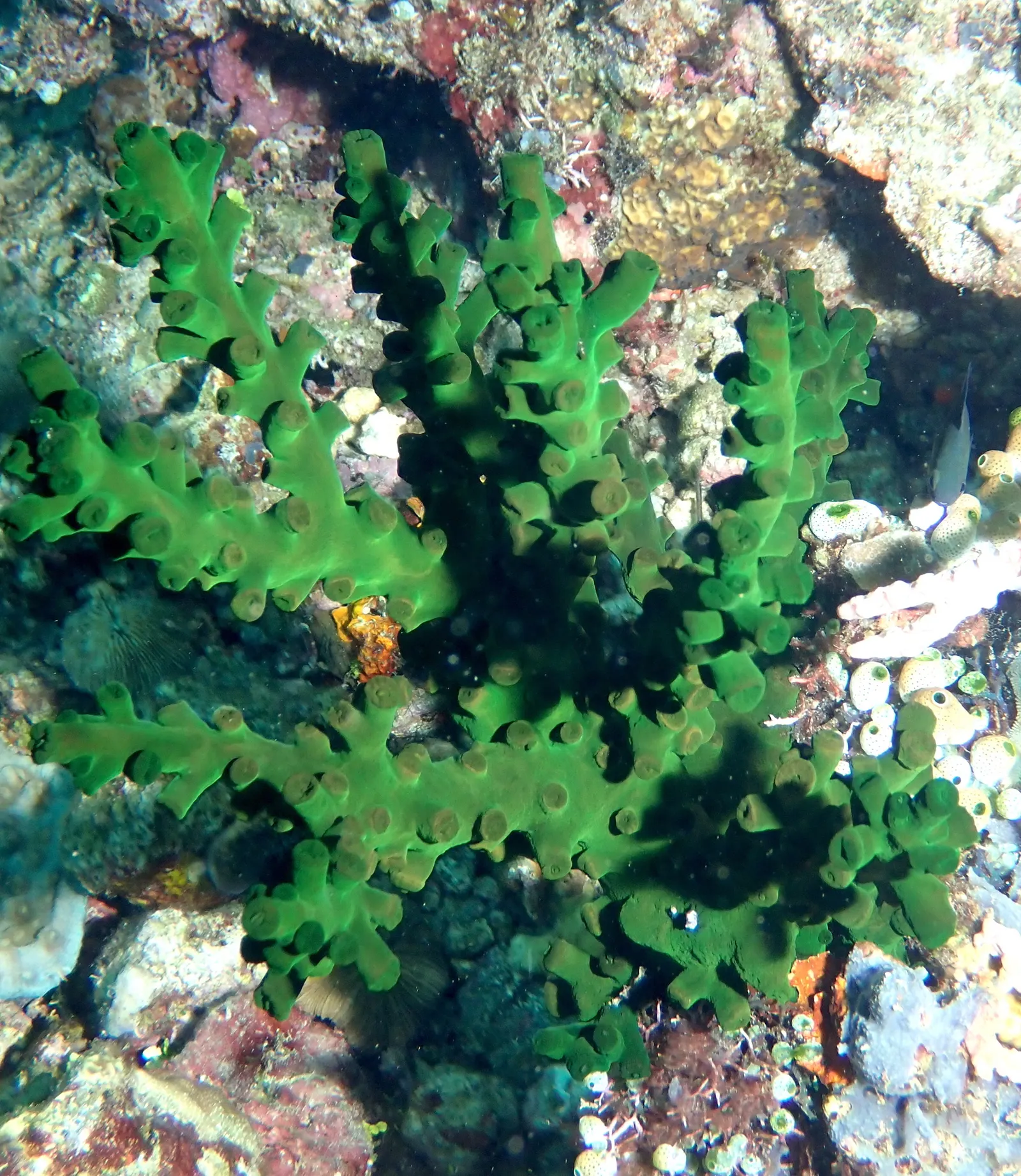
A dark green, almost black coral tree swaying in the current – the giant of the cup corals, growing into a bush without any light.
At first glance the black sun coral (Tubastraea micranthus) looks more like a bush than a coral: its dark green, almost black, tree-like branching colonies reach out from walls and wrecks into the current. Up close the branches are covered in small tube-shaped cups – the same construction as its orange cousin, just in a dark edition and far larger: it is the biggest-growing species of the genus.
Like its cousin it has no zooxanthellae: it does not photosynthesise but hunts plankton with its polyps, mostly at night and in strong current, when the water keeps delivering dinner. That is why it favours current-swept deeper walls and the exposed edges of wrecks – exactly where light-hungry corals give up, this one bushes out. With polyps open, the dark branches look like a Christmas tree strung with greenish stars.
At Hurghada, look for it on the deeper, current-washed sites: it grows most handsomely on the walls of Carless Reef and Umm Gamar and on the protruding structures of the El Mina wreck, typically below 15 metres. It is slow-growing – a big bush represents decades of work – and a single fin strike can undo it in seconds, so watch your trim carefully in the current.
Did you know?
The black sun coral is the black sheep of the sun coral family twice over: it needs no sunlight and its colour is anything but sunny – its dark pigment likely shields shallower colonies from excess UV radiation.
Where can you meet it?
Find it on the current-swept deeper walls of Carless Reef and Umm Gamar and on the protruding parts of the El Mina wreck, typically below 15 metres.
Frequently asked questions
No, they are two entirely different animals. The black sun coral is a stony coral with dark green living tissue; "true" black coral (Antipathes) is a horny-skeleton species whose skeleton alone is black. Easy to confuse by name – underwater they look completely different.
Because the current is its kitchen: with no algae partners it lives entirely on plankton fished from the water, and the flow keeps delivering fresh supplies to the polyps. Where the water moves strongly, its table is set.
A deeper wall or wreck dive: the handsome bushes usually grow between 15 and 30 metres, often in current. For Advanced-level divers, Carless Reef or the El Mina are the best bets – and with polyps open it truly shows itself on a night dive.
Best sites for Black sun coral
Carless Reef
An offshore twin-erg reef famous for its legendary moray colony – for experienced divers, weather permitting.
- Depth
- 12–30m
- Boat
- 70min
- Species
- 5
Umm Gamar
An elongated island in the north: a plateau with three coral towers, small caves and big predators out in the blue.
- Depth
- 10–30m
- Boat
- 75min
- Species
- 5
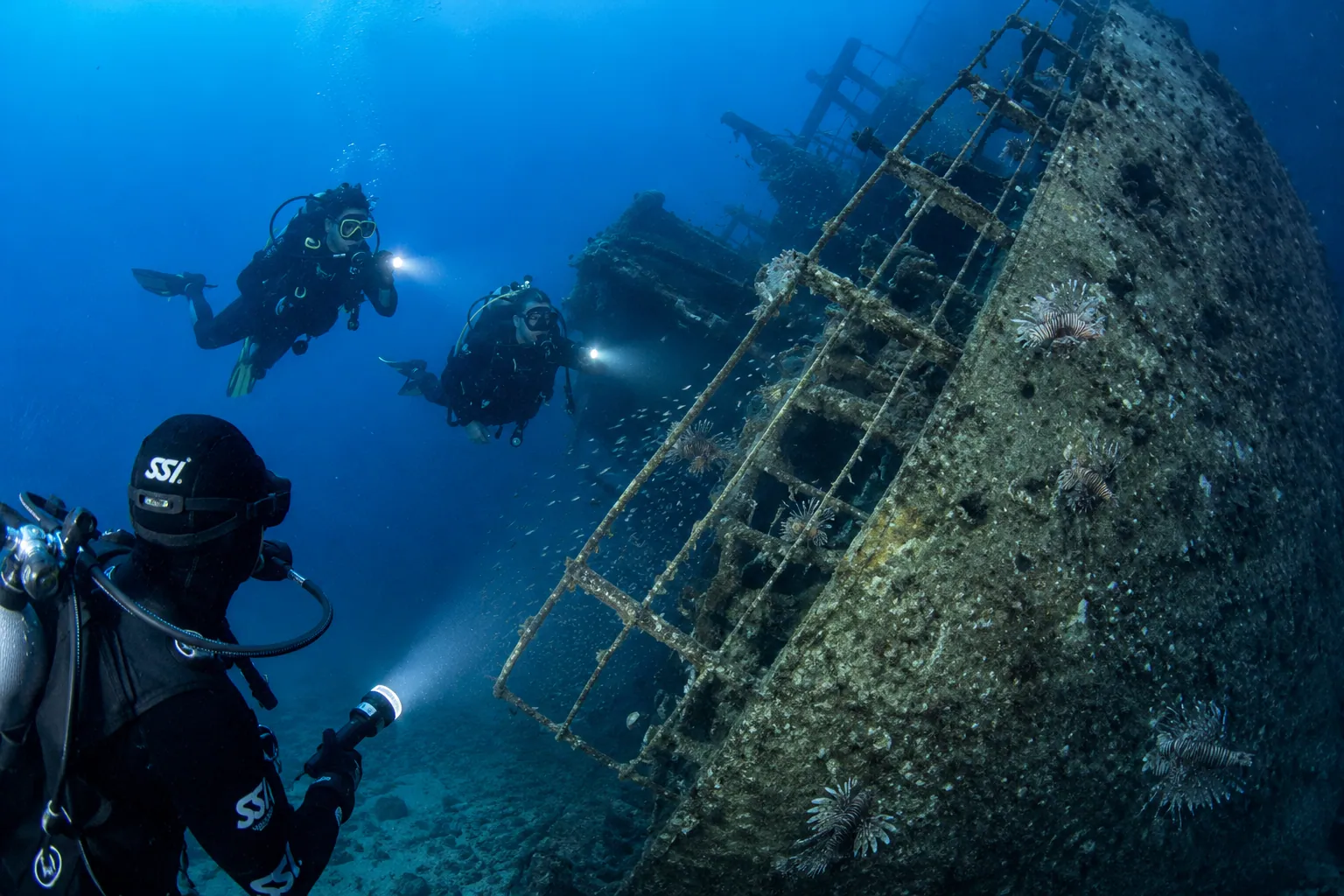
El Mina roncs
A genuine warship wreck 20 minutes from the marina: an Egyptian minesweeper sunk in 1969, resting on sand at 30 metres.
- Depth
- 16–30m
- Boat
- 20min
- Species
- 5
The Red Sea will not wait forever.
Book today – seats on the boat are limited, your excitement is not.