Bluespine unicornfish
Naso unicornis
A real horn on its forehead and two fixed blue blades on its tail – the bluespine unicornfish is the armoured knight of the reef.
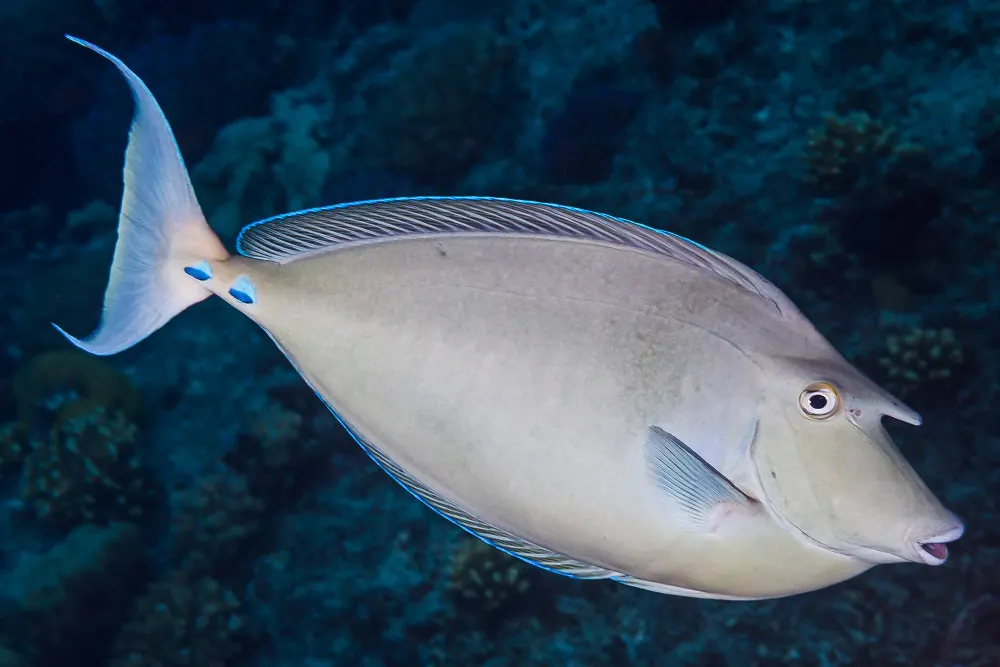
The bluespine unicornfish (Naso unicornis) is one of the oddest-looking fish you can meet around Hurghada: adults grow a bony, forward-pointing horn from the forehead that lengthens with age. Against its olive-grey body, the two pairs of spines on the tail base glow bright sky blue – and unlike the surgeonfishes' folding scalpels, these are fixed, permanently exposed sharp blades that even fishermen handle with respect.
It feeds on larger algae: its favourite is leafy brown seaweed, which it grazes from the reef edge and shallow lagoons. This gives it a key role in reef health, preventing fast-growing algae from smothering the corals. By day it cruises the reef slope alone or in small groups, often at the boundary of open water – a powerfully built, excellent swimmer that is perfectly at home in the surge zone.
It is a regular sight on Hurghada's reefs: along the outer walls of the Giftun Islands, on the slopes of Abu Ramada or on the deeper rim of Umm Gamar it swims the border between blue water and coral. As a snorkeler you may bump into it above the reef top, and as a diver it pays to watch the "traffic" along the slope – that horned silhouette cannot be mistaken for anything else.
Did you know?
The horn is not actually a weapon: it never rams with it, and researchers still debate its exact purpose. Males, however, can light up their blue markings in a flash when showing off – the horn is just the "crown" for the show.
How to behave around it
A peaceful herbivore that never attacks on its own, but the blue blades on its tail base are permanently exposed and very sharp. Never try to grab it or corner it – watched from a few metres away it is completely harmless.
Where can you meet it?
Look for it along reef slopes and outer walls: it appears regularly at the Giftun Islands, on the Abu Ramada slopes and along the rim of Umm Gamar.
Frequently asked questions
It does not ram – the horn is not a weapon and the fish is decidedly peaceful. The only thing to respect is the two pairs of sharp blue blades at its tail base: they are permanently exposed, so the fish should never be handled. As a diver or snorkeler you have nothing to fear.
Yes, it often grazes on the shallow reef top and the surge-washed edge where its favourite brown algae grow. The bigger individuals tend to cruise along the slope, where divers have the better chance.
Honestly: nobody knows for certain. It is definitely not used as a weapon; most likely it serves as a signal to other unicornfish – the older and stronger the fish, the longer the horn. Juveniles have none at all.
Best sites for Bluespine unicornfish
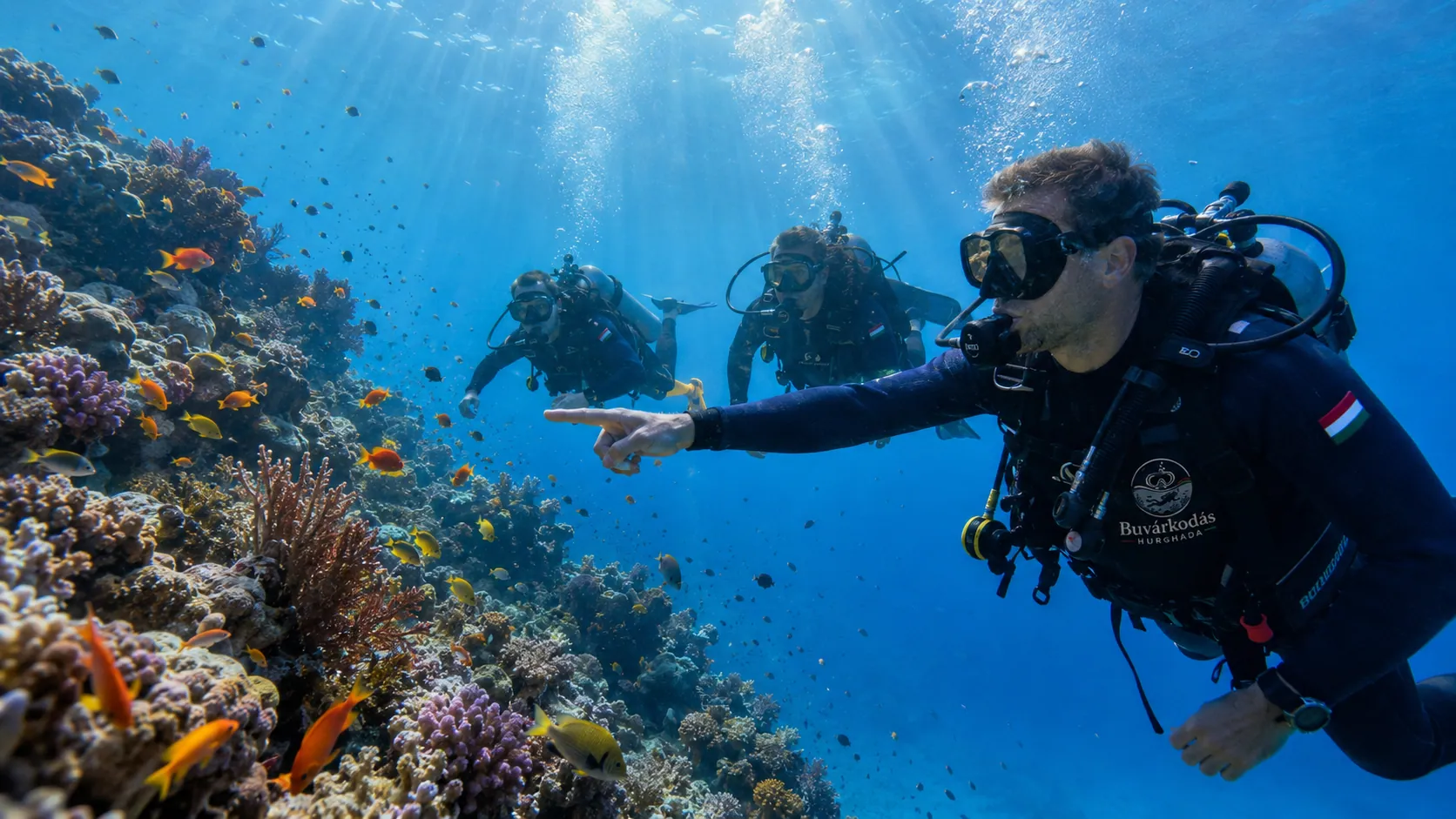
Giftun-szigetek
A national park island pair with a dozen dive sites: coral gardens, turtles and perhaps the richest fish life in the area.
- Depth
- 5–25m
- Boat
- 45min
- Species
- 6
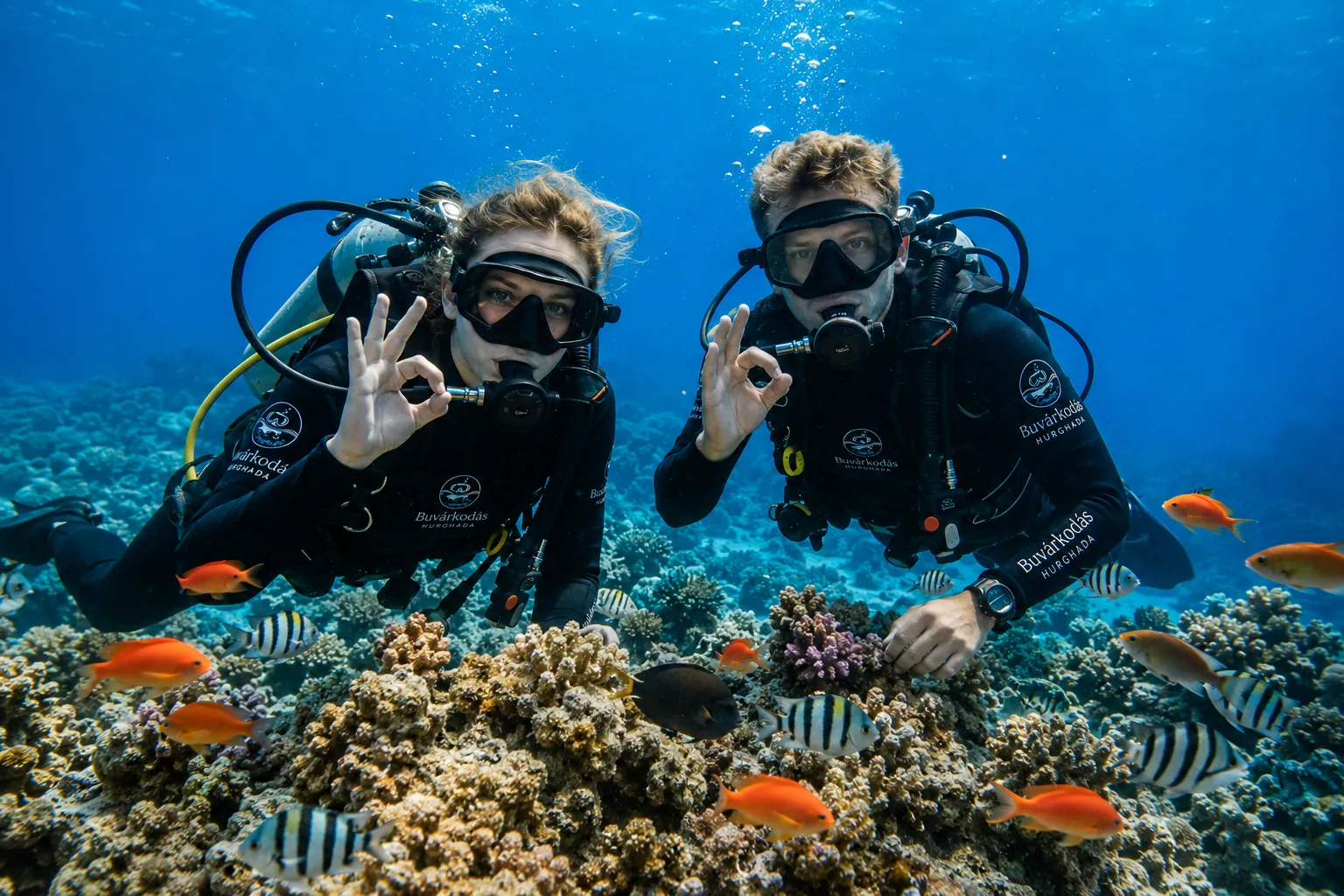
Abu Ramada („Az Akvárium”)
The Aquarium nickname is well earned: the fish schools swirling around the coral towers can be so dense you lose sight of the reef.
- Depth
- 6–26m
- Boat
- 50min
- Species
- 6
Umm Gamar
An elongated island in the north: a plateau with three coral towers, small caves and big predators out in the blue.
- Depth
- 10–30m
- Boat
- 75min
- Species
- 5
The Red Sea will not wait forever.
Book today – seats on the boat are limited, your excitement is not.