Dogtooth tuna
Gymnosarda unicolor
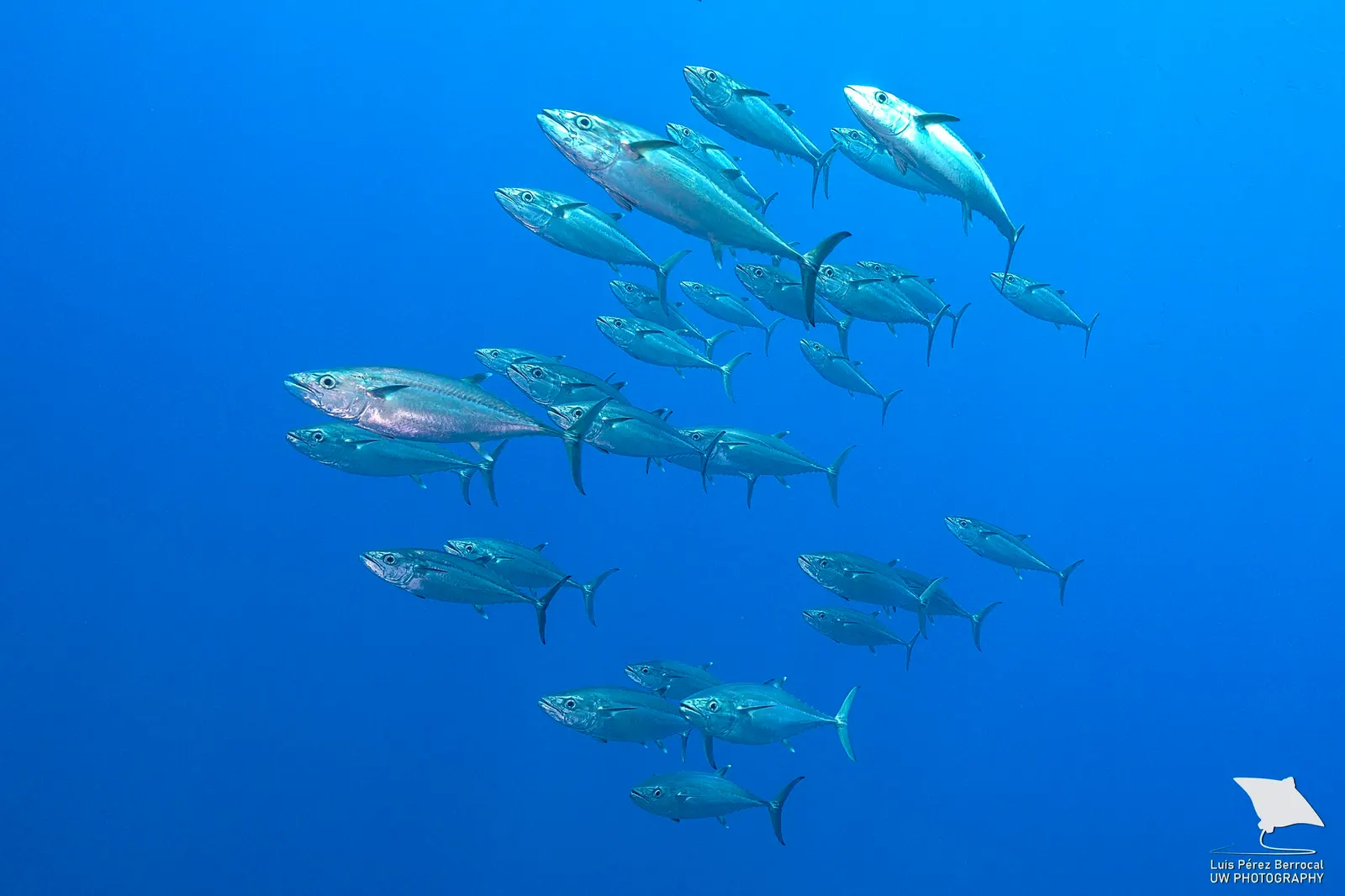
A steel-silver torpedo in the blue: the dogtooth tuna is the lightning-fast hunter of the deep walls, named for its formidable dog-like teeth.
The dogtooth tuna (Gymnosarda unicolor) has a slightly misleading name: it is not a "true" tuna but the largest bonito in the mackerel family. Its torpedo-shaped, gleaming steel-silver body carries a wavy lateral line, and its large eyes and strong conical teeth show even when the mouth is closed – hence the "dogtooth" name. Around Hurghada, fish of 100–150 cm are typical, though the species can grow considerably larger.
Most tunas roam the open ocean, but the dogtooth stays loyal to the reefs: it patrols steep walls and current-swept corners, alone or in small groups. It hunts fusiliers, sardines and other schooling fish with sudden, explosive charges that make the school burst apart like a silver cloud. Yet this lightning-fast predator sometimes slows down surprisingly: it regularly visits cleaner wrasse stations, hovering with its mouth wide open while the little fish give it a "dental check-up".
Around Hurghada your best chances are at the deeper, current-exposed outer reefs: individuals occasionally cruise past in the blue along the walls of Umm Gamar and Carless Reef, and at the Small Giftun drop-off. The trick is simple: while swimming along the wall, turn towards open water now and then and scan the blue – the silver flash of a dogtooth tuna sweeping past can be the most memorable moment of your dive.
Did you know?
One of the sea's fastest predators regularly "sits in the dentist's chair": at cleaning stations it hovers motionless with its mouth agape while finger-sized cleaner wrasses pick its teeth and gills clean.
Where can you meet it?
Look for it at the deeper, current-swept outer reefs: it appears out of the blue along the walls of Umm Gamar and Carless Reef and at the Small Giftun drop-off.
Frequently asked questions
Not at all. Those fearsome teeth are strictly for schooling fish – at most a dogtooth tuna will grant divers one curious pass before vanishing into the blue. Consider yourself lucky if it comes close at all: it usually keeps its distance.
No: canned tuna comes mostly from open-ocean tuna species. The dogtooth is the largest of the bonitos and, almost uniquely among its relatives, hunts along coral reef walls instead of roaming the open ocean.
Pick the deeper, current-swept sites – Umm Gamar, Carless Reef, Small Giftun – and scan the open blue regularly as you swim along the wall. The dogtooth appears out of nowhere and vanishes just as fast.
Best sites for Dogtooth tuna
Umm Gamar
An elongated island in the north: a plateau with three coral towers, small caves and big predators out in the blue.
- Depth
- 10–30m
- Boat
- 75min
- Species
- 5
Carless Reef
An offshore twin-erg reef famous for its legendary moray colony – for experienced divers, weather permitting.
- Depth
- 12–30m
- Boat
- 70min
- Species
- 5
Small Giftun fal
Hurghada's classic drift dive: a sheer wall with gorgonian fans, eagle rays and a coral-tower plateau at 20–30 metres.
- Depth
- 8–30m
- Boat
- 50min
- Species
- 5
The Red Sea will not wait forever.
Book today – seats on the boat are limited, your excitement is not.