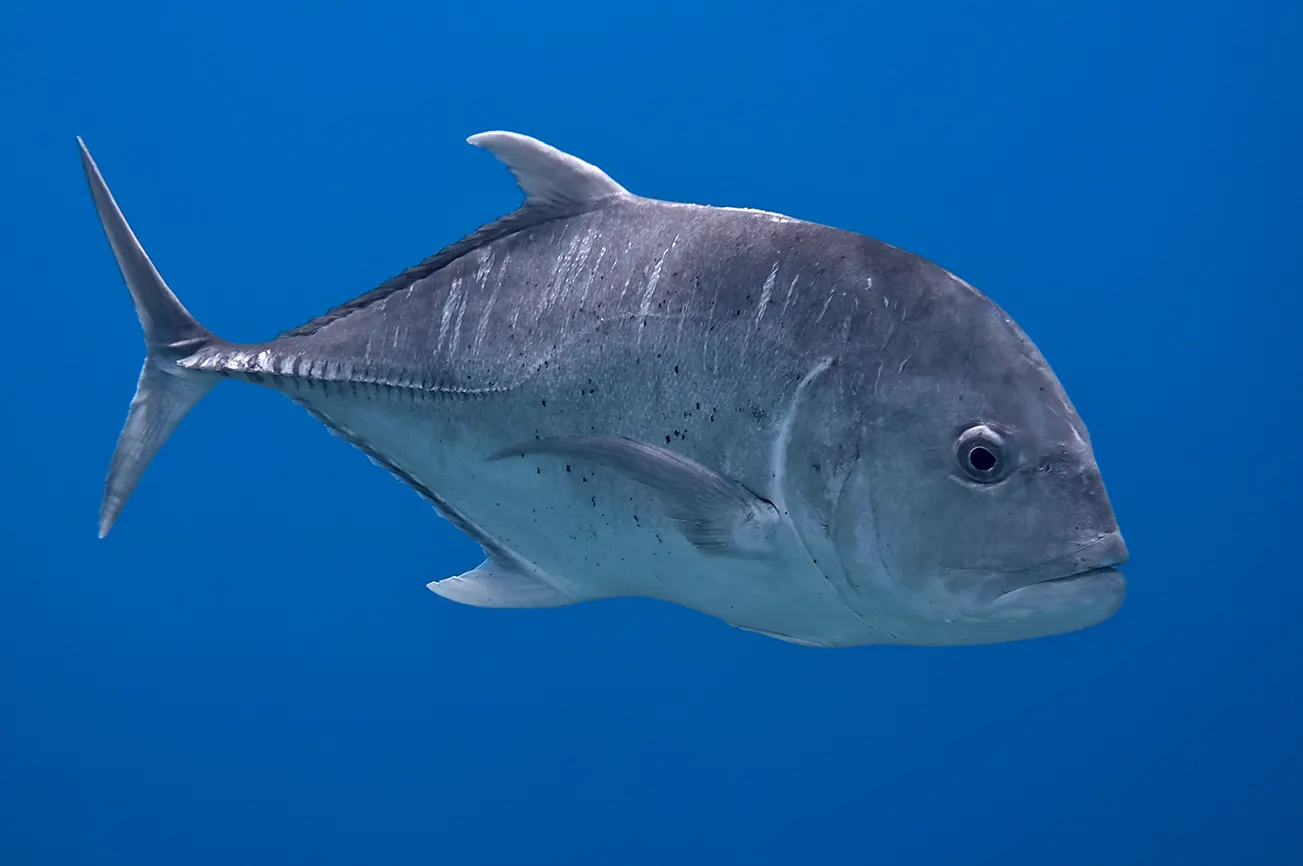
Giant trevally
Caranx ignobilis
When a silvery fish the size of a wardrobe door glides out of the blue and the schools scatter before it – the boss of the reef, the GT, has arrived.
The giant trevally (Caranx ignobilis) – simply "GT" to divers and anglers – is the largest member of the trevally family: exceptional individuals reach 170 centimetres and 80 kilograms, though around Hurghada you typically meet fish in the metre class. The massive, steep-browed head and thick silvery body command respect from a distance; older males darken to almost pure black, making their appearance even more dramatic.
It is an apex predator at the top of the reef's food chain, handling fish, crustaceans and occasionally even young seabirds. It hunts mostly at dawn and dusk, in the in-between light, charging into the schools with brutal power – the whole reef feels its presence. Juveniles grow up in sheltered bays, sometimes in groups, while adults are mostly solitary wanderers covering large territories.
Around Hurghada your chances come at the deeper, current-swept reefs: the encounter is always unexpected and always memorable. The GT is not afraid of divers – it sizes you up in a slow, dignified circle, then decides whether you are interesting. If you turn towards the blue and suddenly feel that "someone is watching", the odds are a giant trevally is hovering at the edge of your vision.
Did you know?
Giant trevallies in the Seychelles leap clear of the water to snatch low-flying young terns in mid-air – an incredible scene filmed by the BBC's Blue Planet II crew, which made the species world-famous.
Where can you meet it?
It roams the deeper, current-exposed reefs: it appears most often along the edges of Carless Reef and Umm Gamar and the wall of Small Giftun – typically on early-morning dives.
Frequently asked questions
No – apex predator or not, humans are not on its menu. At most its size and confident approach can be startling at first: a metre-long GT looks big even circling at a respectful distance. Enjoy the moment, because it is a rare gift.
On early-morning dives at the deeper outer reefs – that is when it hunts most actively. Watch the blue water off the reef edge: a GT typically materialises out of nowhere, makes a circle or two, then disappears.
Colour changes with age and sex: older males grow ever darker until they are almost completely black, while females and juveniles stay silvery. A coal-black GT is therefore very likely an experienced old male.
Best sites for Giant trevally
Carless Reef
An offshore twin-erg reef famous for its legendary moray colony – for experienced divers, weather permitting.
- Depth
- 12–30m
- Boat
- 70min
- Species
- 5
Umm Gamar
An elongated island in the north: a plateau with three coral towers, small caves and big predators out in the blue.
- Depth
- 10–30m
- Boat
- 75min
- Species
- 5
Small Giftun fal
Hurghada's classic drift dive: a sheer wall with gorgonian fans, eagle rays and a coral-tower plateau at 20–30 metres.
- Depth
- 8–30m
- Boat
- 50min
- Species
- 5
The Red Sea will not wait forever.
Book today – seats on the boat are limited, your excitement is not.