Klunzinger's soft tree coral
Dendronephthya klunzingeri
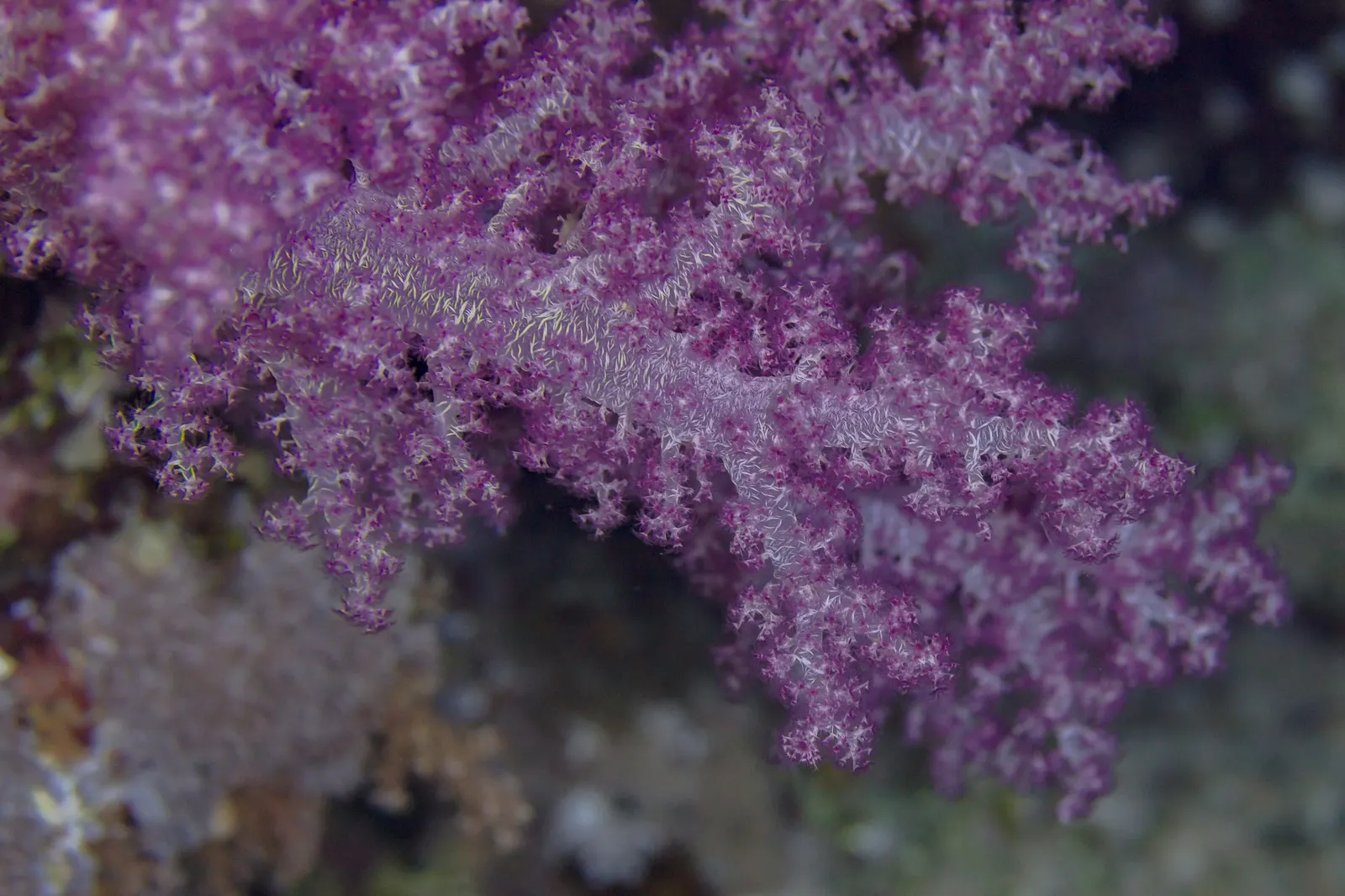
A spiky bouquet in shades of pink, purple and white on the walls – bearing the name of the Red Sea's first great naturalist.
Klunzinger's soft tree coral is a close relative of the red soft tree coral and shares the same glass-ornament beauty: needle-shaped limestone sclerites shimmer through its translucent, water-filled trunk, bristling in spiky little bundles around the polyps at the branch tips. Its palette is perhaps even richer than its cousin's: pink, crimson, purple and snow-white colonies often grow side by side, making the wall look as if someone had pinned wildflower bouquets into it.
Like every Dendronephthya, this species lives without algae: it feeds not on sunlight but on tiny plankton sieved from the water, which makes it a resident of current-swept walls, outcrops and cave mouths. The colony inflates itself with water: in strong current it opens to several times its size, in still water it shrinks. It is named after Carl Benjamin Klunzinger, the German physician-naturalist who, working from El Quseir in Egypt from the 1860s, was the first to scientifically describe much of the Red Sea's marine life.
Around Hurghada you will find it on the deeper walls and passages: besides Carless Reef and the El Mina wreck area, the Small Giftun wall and the deeper rims of Abu Ramada are full of it. Photographers should try backlight or side light – that is when the sclerites glowing through the translucent tissue look their best. The colony is extremely soft and fragile, so your buoyancy must be flawless: watch it, light it, never touch it.
Did you know?
Its namesake, Carl Klunzinger, worked as a quarantine doctor on the Red Sea coast and collected marine animals after hours – as a hobby he wrote the first great systematic works on Red Sea life, still consulted by researchers today.
Where can you meet it?
It blooms on the deeper walls: whole colourful fields of it grow on the walls of Carless Reef and Small Giftun, along the rims of Abu Ramada and around the El Mina wreck.
Frequently asked questions
They are sister species, and underwater they are not always easy to tell apart. Klunzinger's colonies are usually bushier and denser, with a wider palette running from pink through purple to white, while hemprichi leans red-orange. For a diver it hardly matters: both are gorgeous.
One hundred percent animal – more precisely, a shared colony of thousands of tiny animals called polyps. Every "petal" you see is an eight-armed polyp snatching plankton from the water. The bouquet look is pure disguise: corals are relatives of jellyfish and sea anemones.
The colour comes from pigments in the sclerites and tissues and varies genetically from colony to colony – like hair colour in humans. Since the species does not depend on light and colours fade to grey at depth anyway, flamboyant shades cost it little – and it is the splintery sclerites, not the colour, that keep fish away.
Best sites for Klunzinger's soft tree coral
Carless Reef
An offshore twin-erg reef famous for its legendary moray colony – for experienced divers, weather permitting.
- Depth
- 12–30m
- Boat
- 70min
- Species
- 5
Small Giftun fal
Hurghada's classic drift dive: a sheer wall with gorgonian fans, eagle rays and a coral-tower plateau at 20–30 metres.
- Depth
- 8–30m
- Boat
- 50min
- Species
- 5
Abu Ramada („Az Akvárium”)
The Aquarium nickname is well earned: the fish schools swirling around the coral towers can be so dense you lose sight of the reef.
- Depth
- 6–26m
- Boat
- 50min
- Species
- 6
The Red Sea will not wait forever.
Book today – seats on the boat are limited, your excitement is not.