Lunar-tailed bigeye
Priacanthus hamrur
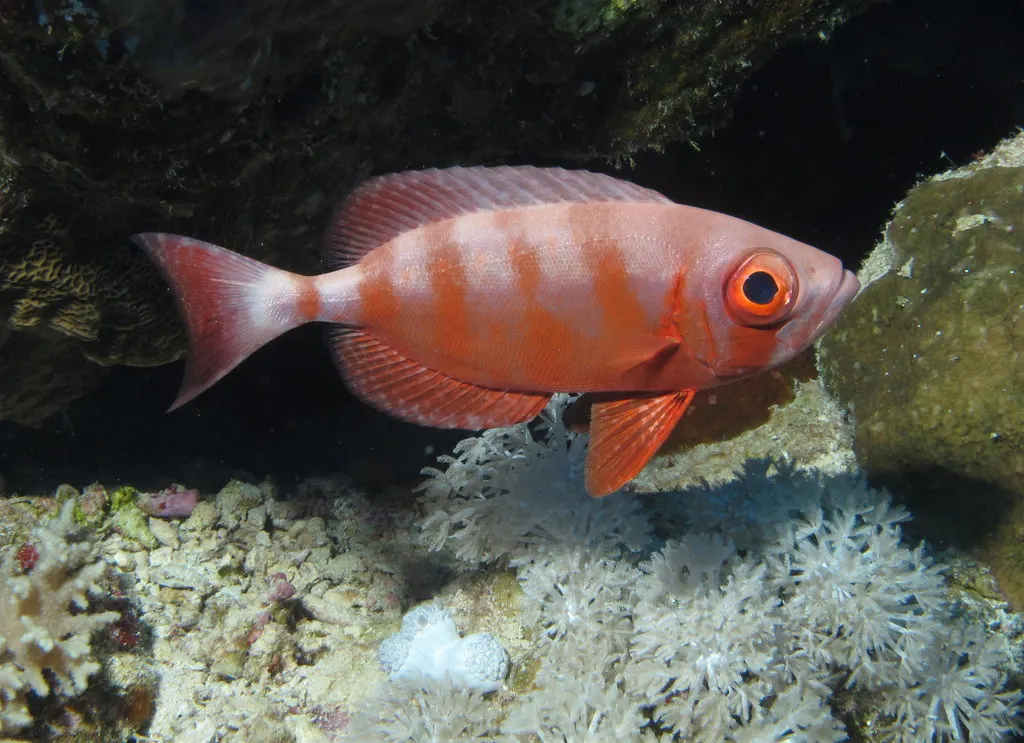
The red ghost of the reef walls: it stares into the gloom with oversized eyes and flips from deep crimson to gleaming silver in seconds.
The lunar-tailed bigeye (Priacanthus hamrur) is a laterally compressed, oval fish whose enormous, metallic-sheened eyes take up nearly half its head. Its base colour is deep crimson or coppery red, yet depending on mood it can switch to silver or a red-and-silver blotched pattern within moments. Both its common names refer to the crescent-shaped tail fin, whose tips lengthen into elegant sickles on older individuals.
It is a nocturnal hunter: after dark it moves away from the reef wall to take larger zooplankton, shrimps, small squid and fish larvae. By day it hovers beside the ledges of deeper walls and plateaus, sometimes alone, sometimes in impressive tightly packed schools of several dozen fish that sway together in the gentle current as a single body. The oversized eye is, once again, an adaptation to hunting in dim light.
Around Hurghada you typically meet it below 15 metres, which makes it a diver's treat rather than a snorkeler's. Red schools drift regularly along the deeper plateaus of Carless Reef and Umm Gamar, off the Small Giftun wall and around the El Mina wreck. Approach slowly along the wall: one sudden move and the whole school turns as one, flashing a dramatic colour change to let you know you have been noticed.
Did you know?
It is a lightning-fast colour changer: its nervous system directly controls the pigment cells in its skin, flipping it from deep crimson to mirror silver in seconds – divers literally watch it toggle between the two modes.
Where can you meet it?
A resident of Hurghada's deeper walls: its schools are common on the plateaus of Carless Reef and Umm Gamar, along the Small Giftun wall and around the El Mina wreck.
Frequently asked questions
Rarely, because by day it typically stays deeper than 15 metres along the walls. This species is really a diver's reward – you stand a good chance of meeting a red school on your very first deeper Hurghada dive.
Colour change is its mood and status signal: at rest it is often silvery, switching to deep red or blotched when disturbed or courting. Red also looks black at depth, so the same trick doubles as camouflage for night hunting.
No – it is a completely harmless plankton-hunting predator with humans nowhere on its menu. Feel free to swim up beside the school – just do it slowly so they don't scatter before your photo.
Best sites for Lunar-tailed bigeye
Carless Reef
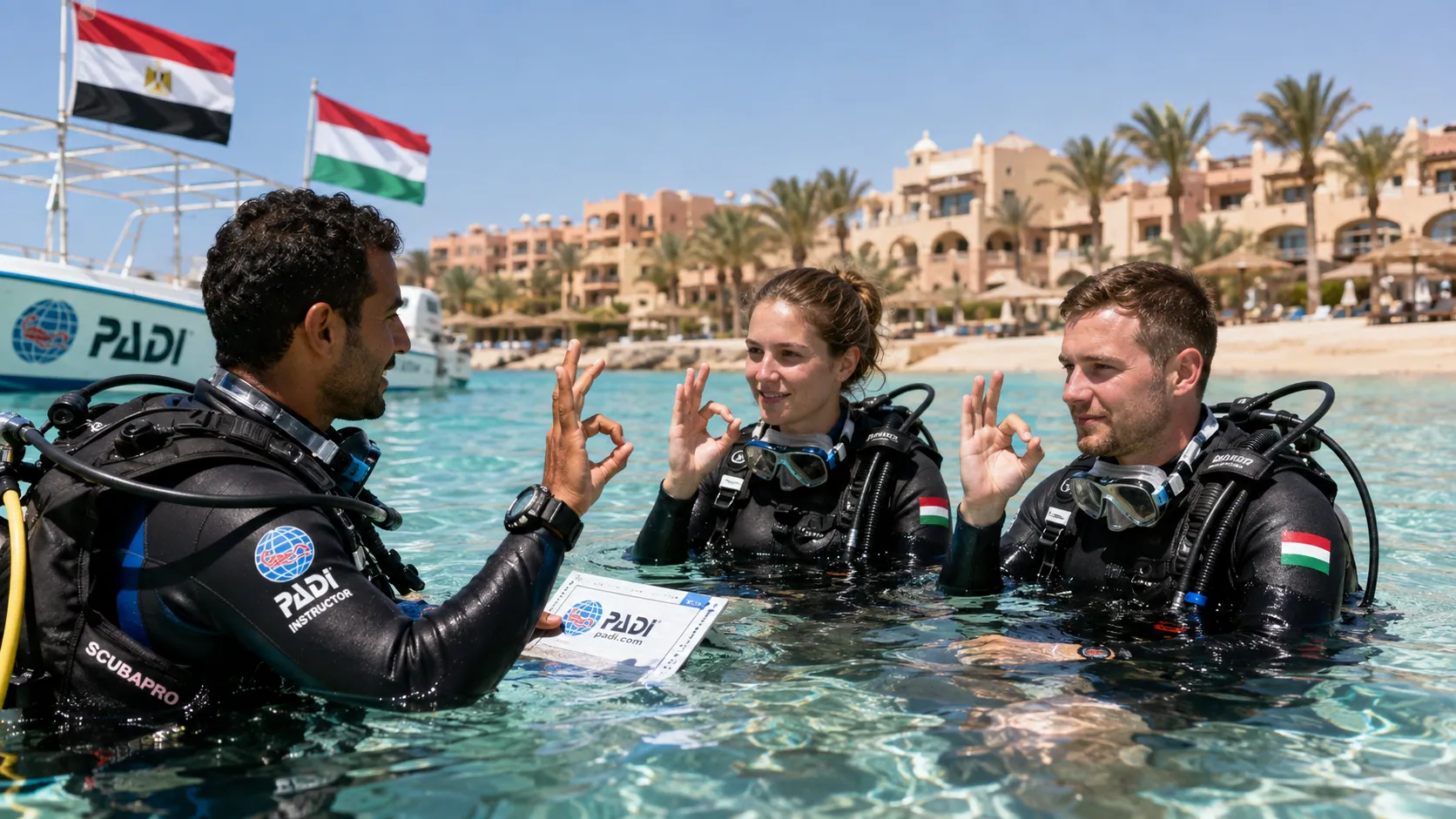
An offshore twin-erg reef famous for its legendary moray colony – for experienced divers, weather permitting.
- Depth
- 12–30m
- Boat
- 70min
- Species
- 5
Umm Gamar
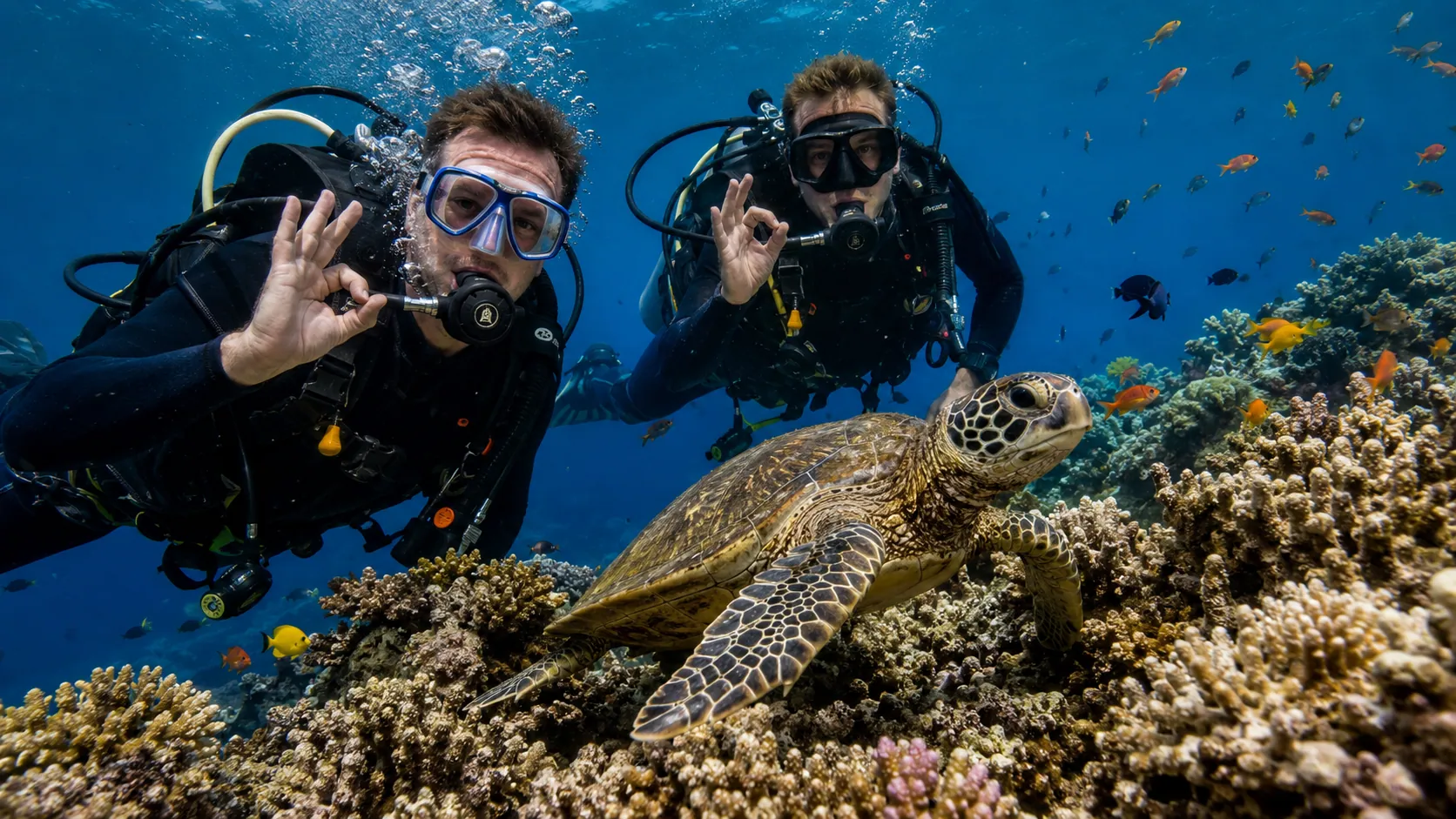
An elongated island in the north: a plateau with three coral towers, small caves and big predators out in the blue.
- Depth
- 10–30m
- Boat
- 75min
- Species
- 5
Small Giftun fal
Hurghada's classic drift dive: a sheer wall with gorgonian fans, eagle rays and a coral-tower plateau at 20–30 metres.
- Depth
- 8–30m
- Boat
- 50min
- Species
- 5
The Red Sea will not wait forever.
Book today – seats on the boat are limited, your excitement is not.