Roving coralgrouper
Plectropomus pessuliferus
A metre-class, blue-spotted top predator that learned something in the Red Sea few fish know: how to hunt as a team with a moray eel.
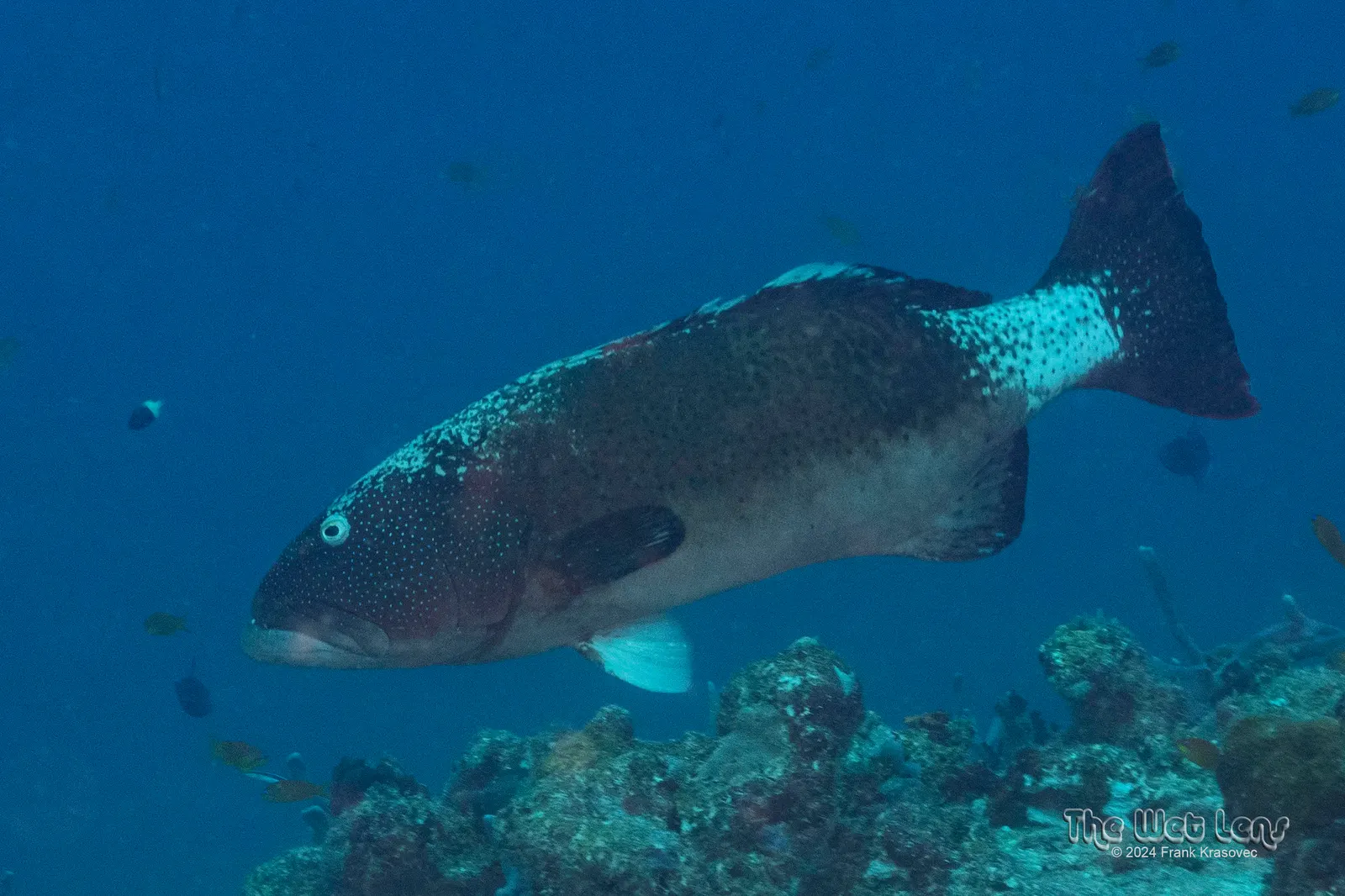
The roving coralgrouper (Plectropomus pessuliferus) is one of the most imposing predators on Hurghada's reefs: adults reach 70–90 cm. Its reddish-brown, sometimes almost brick-red body is sprinkled with small, brilliant blue spots; the head is massive, the mouth wide and armed with pointed teeth – one look tells you it sits at the top of the food chain. The Red Sea population is recognised as a distinct subspecies (marisrubri).
The name is well earned: unlike most groupers it does not sit at an ambush post all day but actively patrols along the reef, covering large areas in search of prey. Its most famous trick, however, is interspecies teamwork: it was in the Red Sea that scientists first documented the coralgrouper "inviting" a giant moray to a joint hunt with a distinctive head-shake signal. The moray flushes fish out of the crevices while the grouper strikes in open water – together they catch prey neither could reach alone.
Around Hurghada you will most likely meet it along the deeper, current-swept walls and plateaus – Carless Reef and Umm Gamar are classic territory, and it also appears among the deeper blocks of Abu Ramada. It usually cruises alone, eyeing divers from a respectful distance. If you are lucky enough to catch it "negotiating" with a moray, hold still and watch: you are witnessing one of the rarest scenes in the underwater world, live.
Did you know?
The roving coralgrouper was the first fish in which science documented signal-coordinated cooperative hunting between species: in the Red Sea it recruits giant morays with a distinctive head-shake, and the two set off hunting together.
Where can you meet it?
Look for it on the deeper, current-swept sites: it patrols the walls of Carless Reef and Umm Gamar and also appears on the plateaus of Abu Ramada and Small Giftun.
Frequently asked questions
No – although it is a sizeable predator, it sees humans neither as prey nor as a threat. It usually cruises calmly past at a respectful distance; the worst that can happen is that it refuses to pose for your photo.
Rarely – it prefers the deeper walls and plateaus. This is more of a diver's encounter: you have a realistic chance on Carless Reef or Umm Gamar dives, typically below 15 metres.
Yes – and it was proven right here in the Red Sea: the grouper recruits the moray with a head-shaking signal, the eel flushes fish from the crevices while the grouper waits in open water. If you see this on a dive, you are witnessing something truly exceptional.
Best sites for Roving coralgrouper
Carless Reef
An offshore twin-erg reef famous for its legendary moray colony – for experienced divers, weather permitting.
- Depth
- 12–30m
- Boat
- 70min
- Species
- 5
Umm Gamar
An elongated island in the north: a plateau with three coral towers, small caves and big predators out in the blue.
- Depth
- 10–30m
- Boat
- 75min
- Species
- 5
Abu Ramada („Az Akvárium”)
The Aquarium nickname is well earned: the fish schools swirling around the coral towers can be so dense you lose sight of the reef.
- Depth
- 6–26m
- Boat
- 50min
- Species
- 6
The Red Sea will not wait forever.
Book today – seats on the boat are limited, your excitement is not.