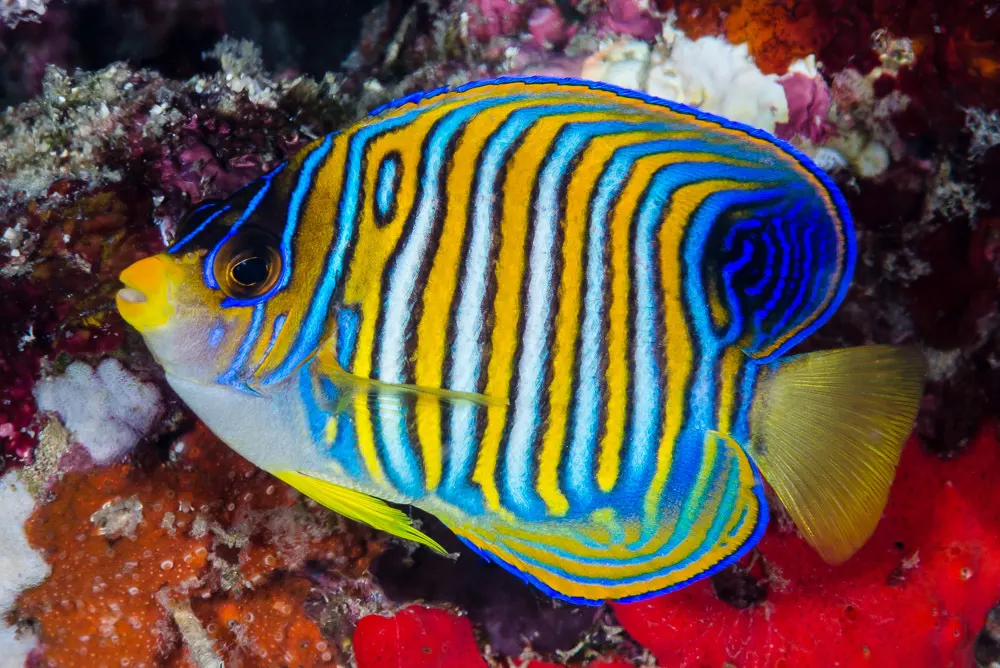
Royal angelfish
Pygoplites diacanthus
With its blue-and-orange stripes it is one of the reef's most beautiful fish – and Red Sea individuals outshine royal angelfish anywhere else.
Even seasoned divers slow down for a royal angelfish (Pygoplites diacanthus): eight to ten slightly slanted blue-and-white stripes edged in black run across its orange body, as if painted on with a brush, and the rear of the dorsal fin is deep blue speckled with light-blue dots. Here comes the local bragging right: the Red Sea population has a vivid orange chest and belly, while its Indo-Pacific cousins are greyish there – the most colourful royal angelfish in the world live right here.
It is the only species in its genus and the pickiest eater among the large angelfish: it feeds almost exclusively on sponges and tunicates, so it always stays near food-rich walls, overhangs and cave mouths. It moves alone or in pairs, and while not exactly shy, it never strays far from cover – one flick of the tail and it vanishes into a crevice.
It is common at Hurghada, but you need to know where to look: not out into the blue but along the wall, at the mouths of swim-throughs and small caves, between 5 and 30 metres. On the walls of Small Giftun and Carless Reef it shows up on nearly every dive. Photograph it side-on, drifting slowly – swim straight at it and it will duck into cover at once.
Did you know?
Beautiful as it is, it is the aquarist's nightmare: the royal angelfish fares poorly in captivity because its sponge diet is nearly impossible to replicate. In the wild it can live 15 years – this is a fish truly best admired on the reef.
Where can you meet it?
It favours walls cut by crevices: a regular on Small Giftun and Carless Reef, and often met at the swim-throughs of El Fanadir and Umm Gamar.
Frequently asked questions
Sometimes, along crevices on shallower reef edges – but its real domain is the wall below 5 metres. Your odds are far better as a diver, especially around small caves and swim-throughs.
Their chest and belly are bright orange, whereas oceanic relatives are greyish-blue there. That is why divers say the finest royal angelfish photos are taken in the Red Sea.
Not at all – it is completely harmless and more afraid of you. The challenge is getting close before it retreats into a crevice: move slowly, breathe calmly, and the photo is yours.
Best sites for Royal angelfish
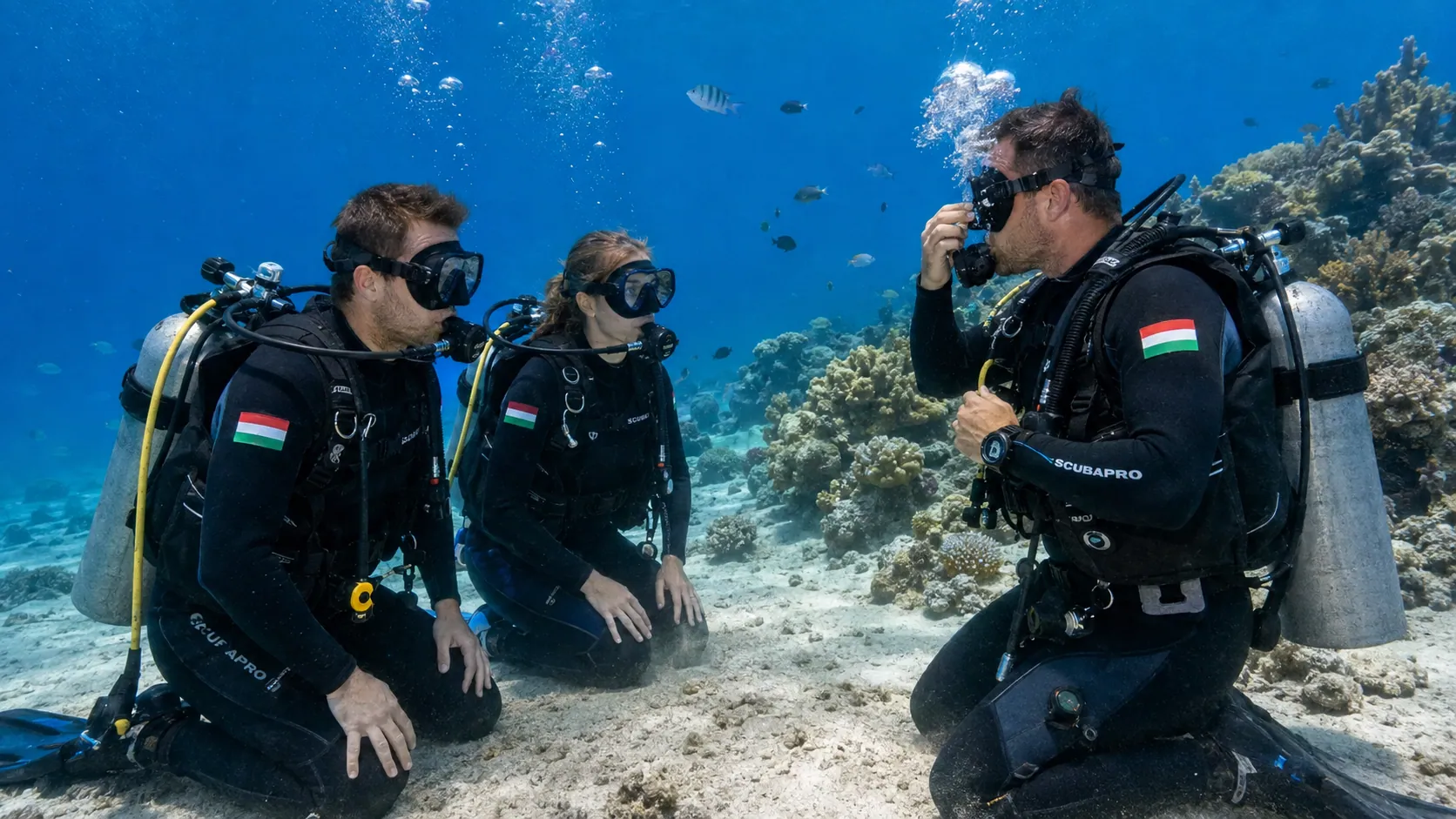
Small Giftun fal
Hurghada's classic drift dive: a sheer wall with gorgonian fans, eagle rays and a coral-tower plateau at 20–30 metres.
- Depth
- 8–30m
- Boat
- 50min
- Species
- 5
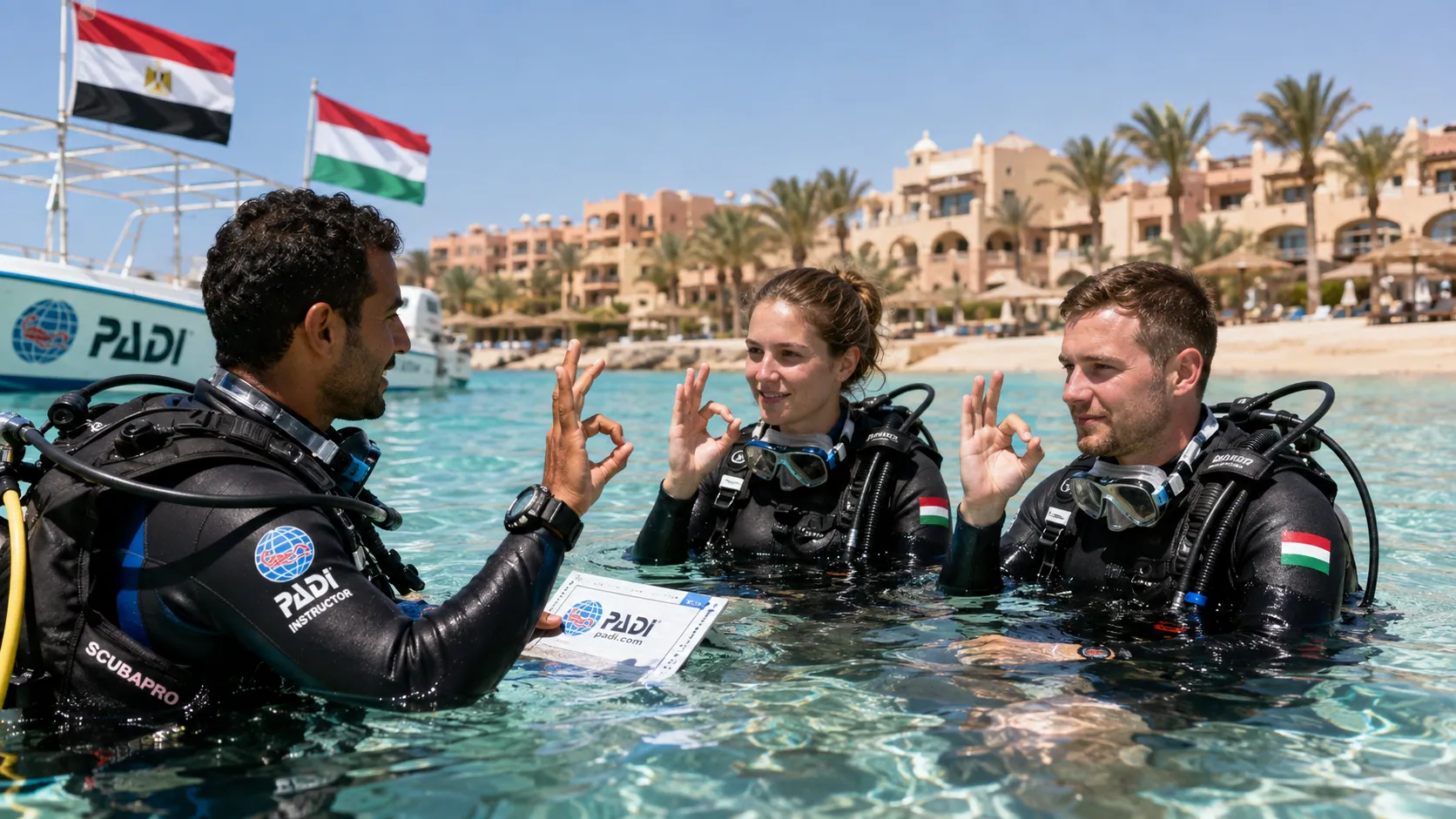
Carless Reef
An offshore twin-erg reef famous for its legendary moray colony – for experienced divers, weather permitting.
- Depth
- 12–30m
- Boat
- 70min
- Species
- 5
El Fanadir
A long reef ridge barely half an hour from the marina: a gentle wall, blue-spotted rays and seagrass patches with turtles.
- Depth
- 6–25m
- Boat
- 30min
- Species
- 5
The Red Sea will not wait forever.
Book today – seats on the boat are limited, your excitement is not.