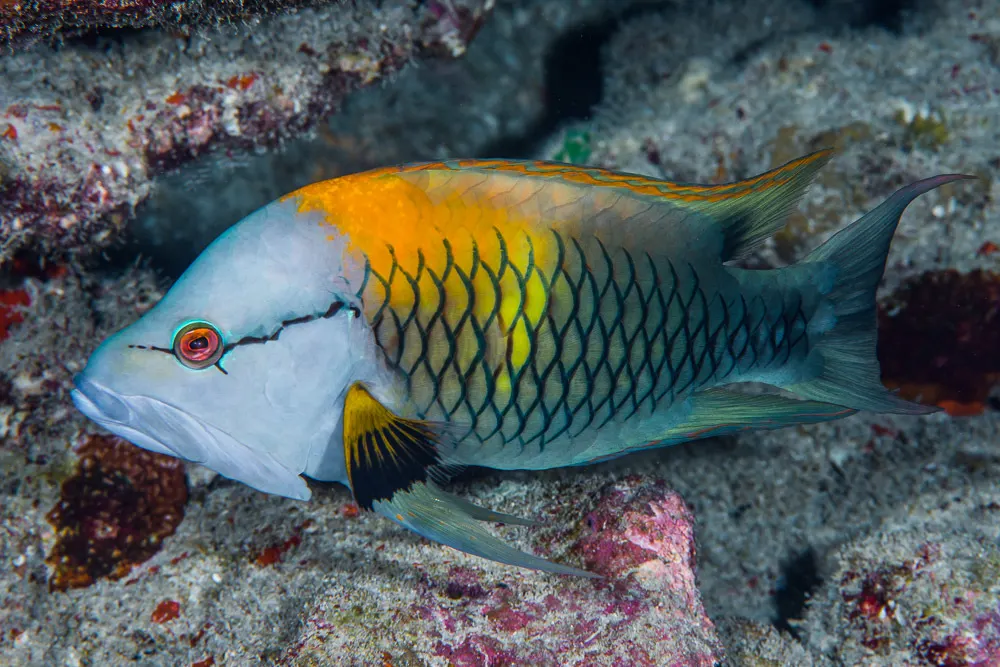
Slingjaw wrasse
Epibulus insidiator
The reef's sharpshooter: in a split second its mouth shoots forward like a tube and sucks in the unsuspecting prey.
At first glance the slingjaw wrasse (Epibulus insidiator) looks like an ordinary deep-bodied wrasse – until it eats. That is when its mouth reveals itself as a folding tube mechanism that shoots forward by more than half its head length in a flash, sucking in prey like a vacuum cleaner. It is one of the most protrusible mouths in the animal kingdom. The scientific name – insidiator, "the ambusher" – describes its hunting technique perfectly.
By colour you would take them for two entirely different fish: females are often brilliant lemon-yellow or brown, while mature males are dark grey with a white head and an orange back. It cruises slowly and gracefully over the coral branches, watching for crabs and small fish – its apparent calm is its weapon, since prey realises too late that it has drifted into firing range. Like most wrasses it starts life as a female and may later turn into a male.
Around Hurghada you can meet it on coral-rich plateaus and slopes: it is not an abundant species, but single individuals turn up regularly on the reefs around the Giftun Islands, El Fanadir and Abu Ramada. The yellow females stand out from far away and can be spotted while snorkeling in shallower water too. If you are lucky enough to catch one hunting, don't blink – the famous jaw strike is almost too fast to follow with the naked eye.
Did you know?
The slingjaw's jaws can shoot forward by up to 65% of its head length in a fraction of a second – the most extreme jaw protrusion of any fish.
Where can you meet it?
Single individuals appear on coral-rich plateaus: your best chances are on the reefs of the Giftun Islands, El Fanadir and Abu Ramada, and the yellow females can be spotted in shallower water too.
Frequently asked questions
Not at all: its famous protrusible mouth is sized for small crabs and fish, and it leaves people alone. It is more wary than curious – consider yourself lucky if it lets you get close.
The brilliant yellow or brown fish are females; the grey ones with a white head and orange back are mature males. They look so different that many people take them for two species – yet it is the same fish at two life stages.
You need some luck: the fish "fires" rarely and lightning-fast. Your best chance is to patiently follow a slowly cruising individual – when it freezes and tilts towards a coral branch, watch very closely.
Best sites for Slingjaw wrasse
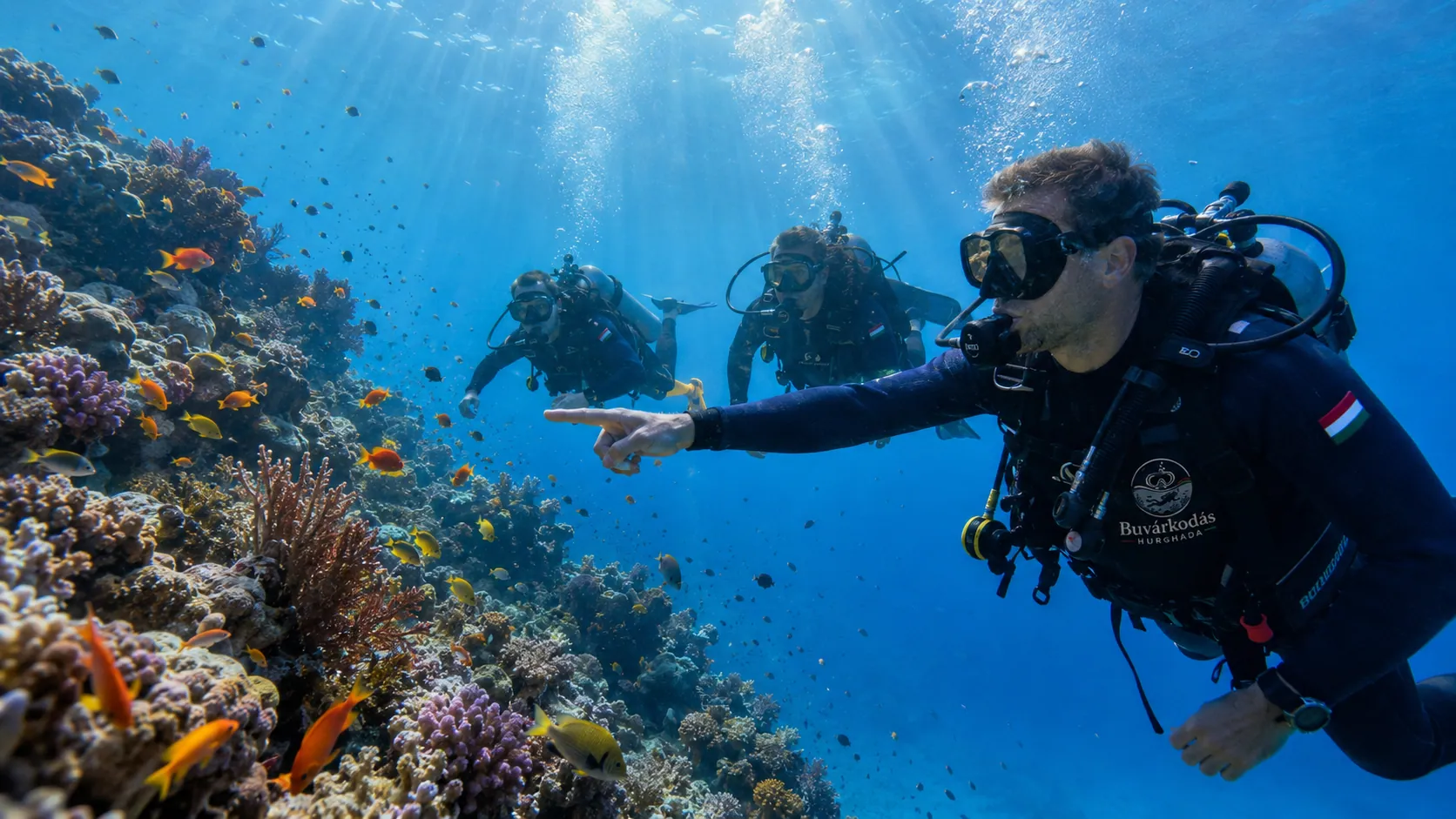
Giftun-szigetek
A national park island pair with a dozen dive sites: coral gardens, turtles and perhaps the richest fish life in the area.
- Depth
- 5–25m
- Boat
- 45min
- Species
- 6
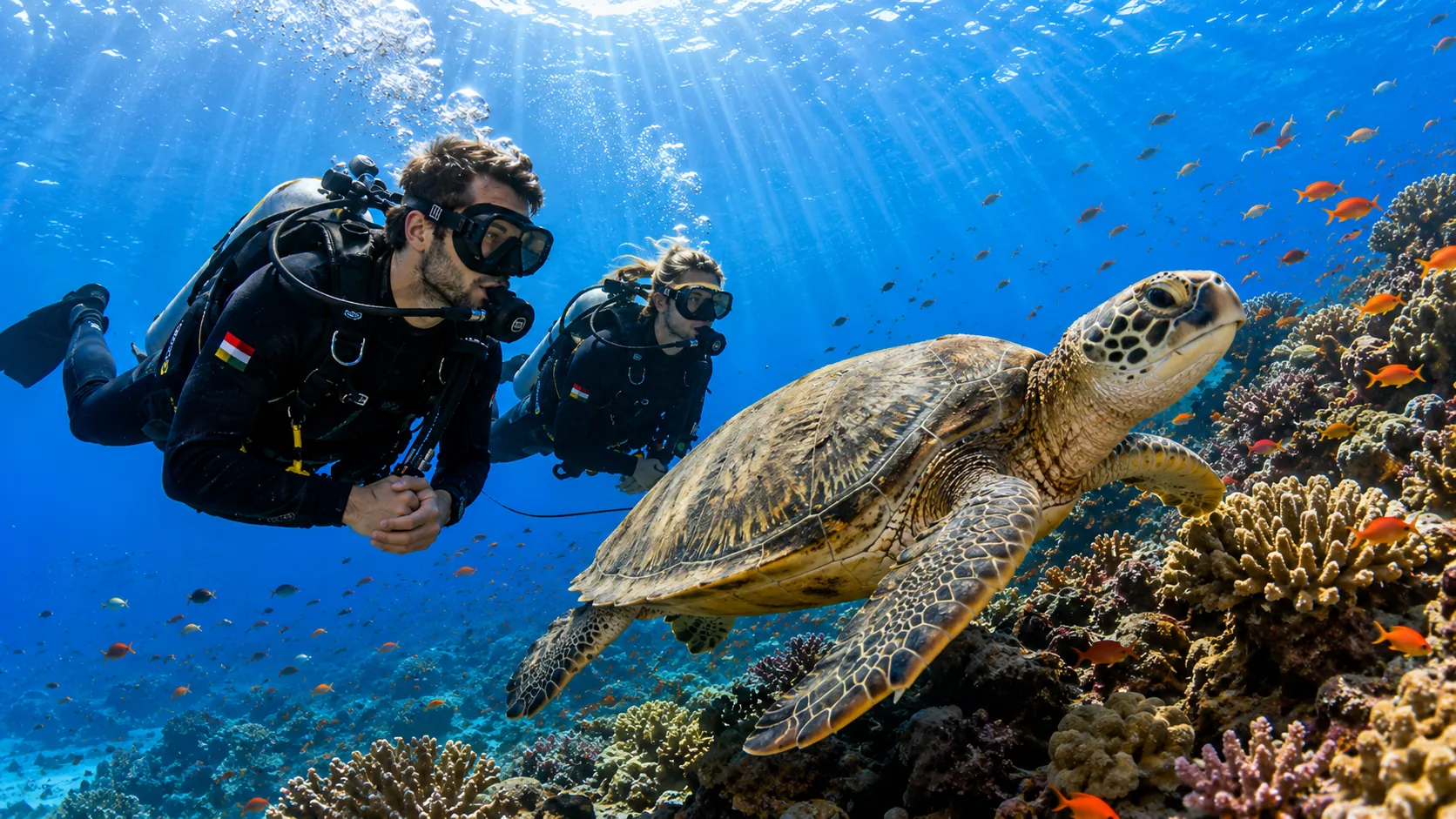
El Fanadir
A long reef ridge barely half an hour from the marina: a gentle wall, blue-spotted rays and seagrass patches with turtles.
- Depth
- 6–25m
- Boat
- 30min
- Species
- 5
Abu Ramada („Az Akvárium”)
The Aquarium nickname is well earned: the fish schools swirling around the coral towers can be so dense you lose sight of the reef.
- Depth
- 6–26m
- Boat
- 50min
- Species
- 6
The Red Sea will not wait forever.
Book today – seats on the boat are limited, your excitement is not.