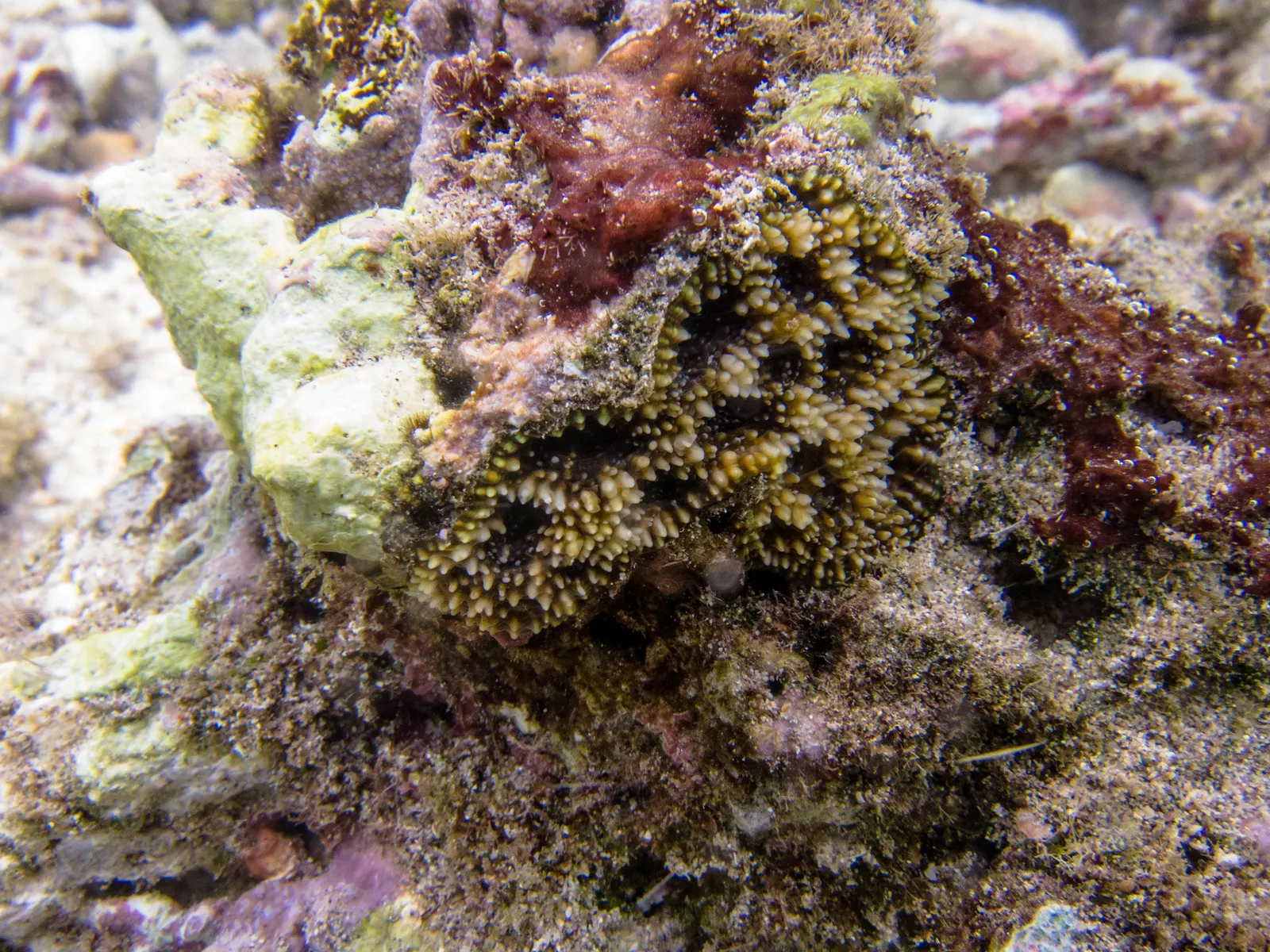
Starry cup coral
Acanthastrea echinata
A fleshy coral with often vivid green-and-red tissue that at night quite literally digests neighbours that stray too close.
At first glance the starry cup coral (Acanthastrea echinata) looks more like a fleshy carpet than a hard coral: its thick, soft-looking tissue almost completely hides the limestone skeleton. Yet beneath that tissue sit large corallites 1–2 centimetres across, their walls edged with spiny little teeth – the source of the species name echinata, meaning "spiny". Its colour range is among the richest on the reef: moss green, brick red, brown and grey mingle across the colony, often with the centres of the cups glowing in a different shade from their rims.
By day the thick tissue billows half-inflated over the skeleton, putting its zooxanthellae to work: photosynthesis provides most of its energy, while at night it extends its tentacles to snatch plankton as well. Growth is slow, spreading as a crust or low cushion, and it reproduces by mass spawning on summer nights. Yet this seemingly placid creature is one of the reef's toughest fighters for space: if a neighbouring coral grows too close, it extrudes its mesenterial filaments onto it at night and digests the rival's tissue outside its own body – by morning only a white, stripped skeleton remains.
Around Hurghada you will find it on sheltered reef slopes and plateaus, typically between 3 and 20 metres – worth seeking on the walls of Umm Gamar and Carless Reef and around the pinnacles of El Aruk, though it can also appear in shallower spots while you snorkel. The fleshy tissue is especially vulnerable: one careless touch or fin kick tears it open, and the wound easily becomes infected. Hover above it with neutral buoyancy, enjoy the colours – but as with every coral, never touch it.
Did you know?
The starry cup coral even deploys its stomach in turf wars: at night it pushes its digestive filaments outside its body and digests the tissue of a neighbouring coral on the spot – divers find only the stripped white skeleton the next day.
Where can you meet it?
Look for it on sheltered slopes and coral pinnacles: you can meet it on the walls of Umm Gamar and Carless Reef and around the blocks of El Aruk.
Frequently asked questions
The combination of thick, fleshy tissue and large 1–2 centimetre cups is the giveaway: the surface looks more like a soft carpet than stone, often mixing two or three vivid colours. If the cup centres glow in a different shade from their rims, you are on the right track.
Yes, this is well-documented behaviour: at night it extrudes digestive filaments from its cups onto a coral growing too close and breaks down its tissue outside its own body. On the reef the battle is fought over centimetres – and the cup coral fights with chemical weapons.
It poses no danger to you – it deploys its digestive filaments only against rival corals and does not harm people. The danger runs the other way: its fleshy tissue is extremely vulnerable, so never touch it and never stand on the reef – that keeps both of you safe.
Best sites for Starry cup coral
Umm Gamar
An elongated island in the north: a plateau with three coral towers, small caves and big predators out in the blue.
- Depth
- 10–30m
- Boat
- 75min
- Species
- 5
Carless Reef
An offshore twin-erg reef famous for its legendary moray colony – for experienced divers, weather permitting.
- Depth
- 12–30m
- Boat
- 70min
- Species
- 5
El Aruk (Gigi)
A playground of coral towers on white sand: easy navigation, clouds of glassfish and light made for photography.
- Depth
- 5–14m
- Boat
- 35min
- Species
- 5
The Red Sea will not wait forever.
Book today – seats on the boat are limited, your excitement is not.