Yellowmouth moray
Gymnothorax nudivomer
A moray of the deeper walls that flashes a shocking lemon-yellow mouth interior with every gape – one of the Red Sea's most striking warning signals.
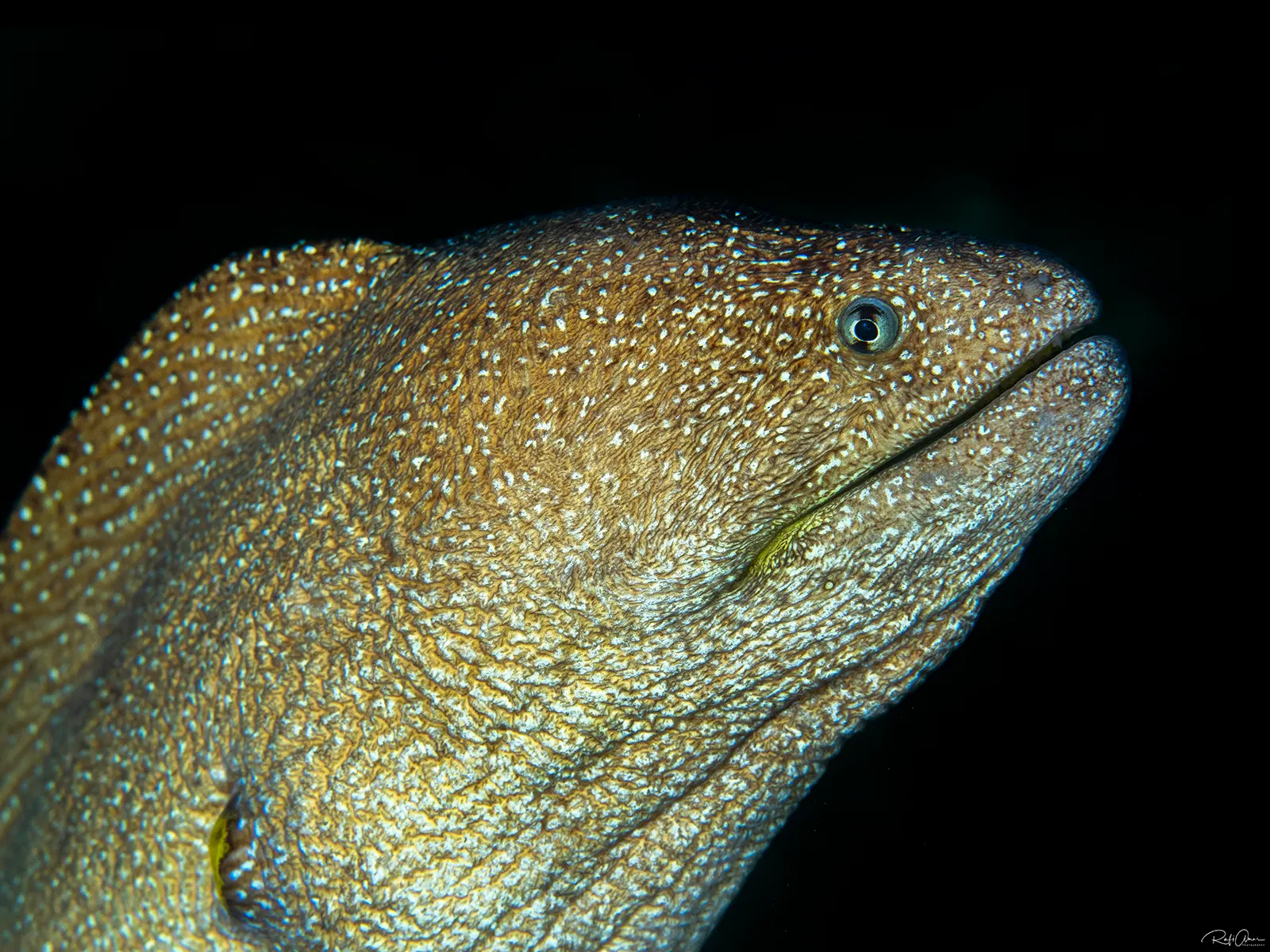
At first glance the yellowmouth moray (Gymnothorax nudivomer) looks understated: a brownish body scattered with small white spots that grow larger towards the tail. The surprise comes when it opens its mouth – the inside is a shocking lemon yellow, and since morays gape constantly as they breathe, the yellow flash carries a long way through the blue gloom.
The species' other speciality is invisible: the mucus coating its skin contains toxic compounds, a genuine rarity among fishes. Toxic slime plus a conspicuous yellow mouth add up to a classic warning system – predators learn that this moray is best left alone. The eel itself sets out at night to hunt fish and cephalopods, spending the day watching the traffic from crevices in the wall.
Around Hurghada it typically lives deep: expect it below 20–25 metres in the holes of steep walls and deeper plateaus, which makes it a resident of the more advanced sites. Diving the walls of Carless Reef and Umm Gamar, peer into the larger recesses – the white-spotted body and that flash of yellow mouth are unmistakable.
Did you know?
The yellowmouth moray is one of the few fish known to have toxic skin mucus – researchers have isolated a toxin from its slime that ruptures red blood cells. The yellow mouth is no fashion statement; it is an honest warning.
How to behave around it
A large moray with a powerful bite, so the rule is simple: don't reach into holes, don't feed it and always leave it an escape route. Its toxic mucus is one more reason never to touch it – though as a diver you have no reason to anyway.
Where can you meet it?
A species of the deeper, advanced sites: your best chances are on the walls of Carless Reef and Umm Gamar and on the deeper plateau of Small Giftun.
Frequently asked questions
It never attacks unprovoked, but as a big moray it can bite hard if harassed, and its skin mucus is toxic. Don't touch, don't feed, and you can watch it in complete safety.
Practically no: this species typically lives below 20 metres in wall crevices. Seeing it means diving, ideally at advanced sites like Carless Reef or Umm Gamar.
It's a warning signal: the yellow flashing with every breath tells predators from afar that this moray, with its toxic mucus, is an unpleasant mouthful. In nature, loud colours are often honest messages.
Best sites for Yellowmouth moray
Carless Reef
An offshore twin-erg reef famous for its legendary moray colony – for experienced divers, weather permitting.
- Depth
- 12–30m
- Boat
- 70min
- Species
- 5
Umm Gamar
An elongated island in the north: a plateau with three coral towers, small caves and big predators out in the blue.
- Depth
- 10–30m
- Boat
- 75min
- Species
- 5
Small Giftun fal
Hurghada's classic drift dive: a sheer wall with gorgonian fans, eagle rays and a coral-tower plateau at 20–30 metres.
- Depth
- 8–30m
- Boat
- 50min
- Species
- 5
The Red Sea will not wait forever.
Book today – seats on the boat are limited, your excitement is not.